Summary
Jay Smith has been teaching that there are many maps that show Arabia in the 7th century. He furthermore claims that Mecca should appear on these maps, and yet it does not. Both of these claims are false.
In reality, there are no 7th century maps of Arabia. There are no original maps. There are no copies of maps. There are no “redacted” maps made in the later Middle Ages or Early Modern Period. This is a confabulation that Jay Smith repeats even though he has been corrected many times. He is unable to understand new information that contradicts older mistaken impressions any longer, so he simply alters the new information in his mind to conform to his confused mistakes, pushing him and his public teaching farther into error.
Additionally, within the maps of Arabia that do exist from other centuries, Mecca is not “missing” from any map on which it should reasonably be expected to appear. Contrary to the script Jay Smith recites, Mecca did not exist as a permanent settlement until ca. 450 AD according to the Islamic sources. Because there are no maps that include any Arabian cities in the 400s through the 800s, there are no maps that are “missing” Mecca.
Making a big deal about maps from earlier centuries “missing” Mecca as a city is like making a big deal about maps from the 1400s and 1500s “missing” New Amsterdam/New York City. New Amsterdam was founded as a settlement in 1625. It is not “missing” from earlier maps because no historical narrative claims that it was a settlement at that time.
This timeline is trivial to verify today. This makes people who repeat the line that “Mecca is missing on maps” appear uneducated, dishonest, or simply stupid. This argument is transparently invalid and should not be used.
Detailed examination of the claims
The argument that “Mecca is missing from maps on which is should appear” is unique to Jay Smith. He claims he is repeating research from others. But his arguments are not found in Patricia Crone’s work, as he often claims, or anyone else’s. Therefore, his specific arguments as well as concessions must be addressed in the detailed analysis of this claim.
First, let us establish a terminus ante quem: the latest possible date at which there can be a question about Mecca’s existence on maps. Jay Smith concedes that Mecca exists on 10th century “maps.” In reality, only one “map” was produced in the entirety of the 10th century that could have included Mecca in its accompanying text (and it does). This map, then, is our end date.
How many maps?
Very simply: If there is no map, then Mecca cannot be “missing” from it.
We will begin by simply tabulating the data: How many “maps” were made that included cities anywhere in Arabia before up to 10th century? This includes the areas that Jay Smith knows are populated, Arabia Petraea and Arabia Felix, as well as the area that Jay Smith falsely believes to be completely unsettled, Arabia Deserta.
Jay Smith does not seem to understand that “maps” of any type were rare in the ancient world and usually included very few cities, if any at all. The first known map that shows any cities was produced in Babylon in the 6th century BC. Between this map in the 6th century BC and the 10th century AD, a period of 1600 years, there were only six works that contained geographical descriptions of Arabia that included any cities in Arabia at all. Two of these works survive only as quotations within a third. So what we have is the following:
Strabo (64 BC – AD 24): Strabo summarizes from two earlier sources, Eratosthenes (276–194 BC) and Artemidorus (ca. 100 BC). Strabo adds new geographical details of Arabia from someone who accompanied the Roman general Aelius Gallus on a specific campaign from Nabataea in Arabia Petraea to South Arabia in Arabia Felix, passing through Arabia Deserta (24 BC). Strabo does not mention Mecca in any of these sources, but no reasonable person could call it “missing” even if it existed as a large city at this time. Artemidorus gives a very sketchy description of the Arabian coast only, while Eratosthenes mentions only one city per kingdom in Arabia Felix and skips over the cities of the incense road and interior entirely, while being clear he is only mentioning select cities. The account of Aelius Gallus likewise mentions only two cities of Arabia Petraea by name, alludes to a third, and then skips over all the cities until Najran. Mecca is near the skipped cities, some of which had been settlements since the Bronze Period.
The Periplus of the Erythraean Sea (ca. AD 59 to 62): A periplus is a sailing itinerary logbook. A periplus describes ports along a coast with occasional notes about important trade-related inland locations that are the source or main destination for important goods. This periplus in particular includes a description of the Arabian coast of the Red Sea and the southern shore of the Arabian Peninsula. Because this is a sailing itinerary, there is no realistic expectation that Mecca, an inland city, should be mentioned. It is not the origin or final destination for any large amount of any important trade good, nor is it the capital of an important kingdom. Other larger inland trading cities on the incense road were not included in this work. Thus no reasonable person could call Mecca “missing” even if Islamic history claimed it existed at this time. However, the periplus does indicate that Jeddah (the Red Sea port closest to Mecca) either did not exist at all or was a small fishing village rather than any kind of destination for trading ships at this time.
Ptolemy (ca. AD 150): This is the first attempt in history to accurately locate all known cities in the world. Similar to other early “maps” containing descriptions of cities, Ptolemy’s Geography survives only as copies of his written description, which contains latitude and longitude data (first introduced by Eratosthenes, though this data doesn’t survive in sources that use him). If there ever was an illustrated proper map, no one recorded seeing it. Ptolemy most likely created his written description for easy circulation so people could produce their own maps from it. His map includes Arabia, so if the Greeks and in Egypt had heard of a city named Mecca, it should be there. This is the only controversial geographic source. Western Orientalists have made several attempts to identify towns in this work with Mecca, and many Muslims have adopted their arguments.
Ibn Hawqal (AD 900s): This is the next map to be produced that includes any city whatsoever in Arabia. Mecca, like all other cities, is in the description that accompanies the map rather than on the map itself. Jay Smith concedes that Mecca is “on” this “map.”
No drawn maps of Arabia
Note that there are few drawn maps from the ancient or early medieval world whatsoever and very, very few that show any cities anywhere in the world. And there are exactly zero drawn maps from the ancient or early medieval world that contain any cities in any part of Arabia. Not one. No drawn maps show Petra in Arabia Petraea. No drawn maps show any of the great cities of South Arabia, Arabia Felix. No maps show any cities at all.
All map illustrations containing Arabian cities are more recent recreations using the surviving descriptions from one of the sources listed above. So what we are working with are copies of the written descriptions or else illustrations made from these descriptions. Fifty different people can make a drawing using Ptolemy, and what you have are fifty different copies or interpretations of the same map, all from ca. AD 150. You do not have fifty different maps. They are still all interpretations of Ptolemy’s single map, and the information in them is still dated to AD 150. This is true if the map is drawn in the 1300s, the 1500s, the 1600s, or yesterday morning. Drawing out Ptolemy’s map doesn’t magically update the information on it to a different year.
There is nothing wrong with this, but it’s something that Jay Smith isn’t able to understand at this point in his life. In his confusion, he falsely portrays different drawings of the same map as different maps and reacts in surprise when they all contain the same information, “even though,” as he says, they are drawn centuries later. He also falsely claims that various maps are “redacted” to the 7th century. This is something he simply confabulates in his confusion. There is no basis for this statement. He makes it up because it is a thought that pleases him and he isn’t able to distinguish reality any longer.
The big gap
It is immediately obvious that there is a big hole between AD 150 and the 900s. There is no “map,” written travel itinerary, or any other systematic geographical description of Arabia or list of its cities that survives from this period.
This does not mean that the cities disappeared for 800 years, only to reappear later. Sailors continued to visit the ports. Over the land, caravans continued to travel the trade routes. Ship pilots and caravan leaders either worked from memory or from written logs that were made for their practical use that no one thought to preserve. There was simply no one from the Greco-Roman scholarly class who felt compelled to make a geographical record of this region for other scholarly class people during this time, as the Greeks and Romans were really the only people in the world interested in this kind of writing. The Sassanian Empire, similarly, has no map-type records at all during this time. Did the vast and wealthy cities of the Sassanian Empire disappear because there was no one making geographical descriptions of the country? Of course not.
Therefore, since available map data does not document anything about any of these regions during this time, we cannot make any conclusions whatsoever about them using maps. You can’t draw conclusion from data that does not exist when there is nothing unusual about the lack of data.
Should Mecca exist on a map of AD 150?
Mecca exists on the 10th-century map of Ibn Hawqal. But before we examine arguments for or against Mecca on Ptolemy’s map, the next nearest map in time, we should ask whether Mecca even should exist on a map produced in AD 150. Was Mecca a settled town of any size in AD 150?
Jay Smith has a script in which he tells us that the “standard Islamic narrative” says that it should because it’s the “oldest city in the world” and then describes a series of events that supposedly happened there in this narrative. This is misleading: the Qur’an calls it the firstsettlement and indicates that it is at the time of Muhammad the major settlement of its immediate region. But the Islamic sources never label it a “city.” In fact, “the city” is Medina (the literal meaning of the new name Muhammad’s followers gave it), which is portrayed as much larger than Mecca.
According to the Islamic narrative, Mecca was entirely abandoned between Noah’s flood and Ishmael and Hagar settling there. When they arrive, it is a barren desert, but Hagar’s pleas cause Allah to make the Zamzam well gush forth like a stream, forming a well-watered oasis. During Ishmael’s lifetime, Abraham teleports there periodically to visit his son and to rebuild the shrine that was destroyed in the flood. This sets the date for the practical establishment of a new Mecca around 2000 or 1750 BC according to Muhammad’s stories.
But this is not the end of the Islamic narrative: because Hagar made an oopsie, the Zamzam well stopped flowing as a spring, the region dried up back into desert, and people stopped living there during Ishmael’s lifetime. Mecca became a place that Arabs reverenced but where no one lived in permanent houses. It was simply the home of a dry desert shrine that the Arabs performed pilgrimage to visit and then left again. This would have made Muhammad’s stories compatible with the historical Mecca that his hearers knew about and lived in.
In Islamic histories, the first person to settle his tribe permanently around Mecca was a pagan man named Qusayy, credited as the great-great-great grandfather of Muhammad (that is, 5 generations). Granting the most common conventional date of Muhammad’s birth of being AD 570 and using 30.7 years as the average generational gap along male lineages, this places a thirty-year-old Qusayy establishing Mecca around AD 447. Even according to the Islamic narrative, this is the first time the shrine had permanent houses since the lifetime of Ishmael, and its identity at this time was as a pagan shrine, though the histories differ on who takes the blame for “making” it pagan.
So let us ask: should Mecca show up on a map of AD 150, when it was not a permanent settlement according to any Islamic source?
The only reason it would be noted is if it was a very famous location that all Arabs knew about and also talked about to foreigners, so famous that Ptolemy would have felt compelled to mark it on his map even though it wasn’t a settlement. There is no indication that this would be true—not in the Islamic sources, and not in any other source.
Is Mecca on Ptolemy’s map of AD 150?
Western Orientalists first introduced the argument that Mecca was on Ptolemy’s map in the 1500s, as Pharan, of all places. At this time, Westerners did not have a sound grasp of what the sources themselves argued, and late folklore and legend about Mecca distorted this narrative similar to how Jay Smith misunderstands the sources. Thus, they expected that such a “great city” would certainly be on maps from the ancient world. But we have already seen that this is an unreasonable expectation, as the recorded memories admit that Mecca had no settlement until ca. AD 450, Muhammad’s stories about the ancient past aside.
If Mecca had existed as a city in AD 150, there is a very good chance that it would be on Ptolemy’s map. There are several very important cities along the Incense Road that Ptolemy is the first to record by name in a geographical work: Hegra, Khaybar, Dumah, and Yathrib/Medina. Hegra or Dumah is alluded to in Strabo’s account from Aelius Gallus but is not named, and Khaybar and Yathrib/Medina are entirely missing, so it is not realistic to expect the much smaller Mecca to be present in this work. If Aelius Gallus didn’t go through Yathrib, then he wouldn’t have passed near Mecca, and if he passed though and didn’t feel it worth mentioning, he wouldn’t be expected to mention passing near but not through Mecca, either. Since, in contrast, Ptolemy does mention these cities, it would be reasonable for Ptolemy to also know about Mecca, if it exists.
Orientalists could not even agree about which of Ptolemy’s cities was meant to be Mecca, but Montgomery Watt popularized the identity of Mecca as being Macoraba, an identity first suggested in 1646 by Samuel Bochart. Watt has such influence that this became essentially the orientalist consensus without much examination for a time. But once examined by such figures as Patricia Crone, there was just as much agreement that the identification has no linguistic merit.
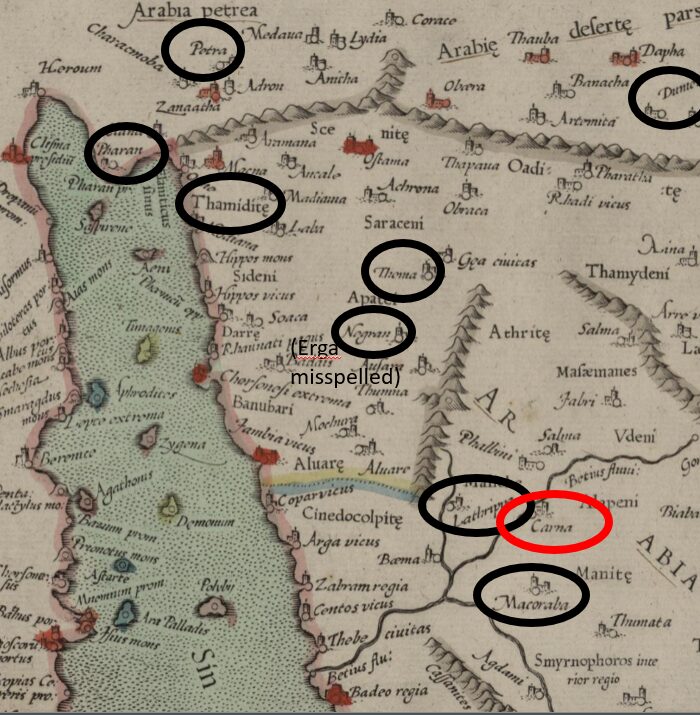
Dan Gibson’s arguments about a Petran location for the first “Mecca” are invalid, but he does make a very good argument from a geographical standpoint that Macroaba is clearly portrayed by Ptolemy to be in Arabia Felix—that is, South Arabia or Yemen—and not in the Hijaz at all. The proof is that Ptolemy places his Macroaba south of a river, and this river has to be in Arabia Felix. Ptolemy simply makes the Hijaz far too small and Arabia Felix far too large, which was the misconception of most Greek and Roman scholars of that time.
Further research confirms Dan Gibson’s argument with a final nail in the coffin for any identification of Macoraba with Mecca: Macoraba is shown south of Karna, the very large city and capital of the Minaean kingdom in Yemen. Whatever mistakes might be made placing cities too far east or west, this is a level of error that is not conceivable.
Included below is a detailed illustration made from Ptolemy’s description. Yathrippa is Yathib, and Carna, circled in red, is Karna. This map has a unique scribal error that changes “Egra” (Ptolemy’s spelling of Hegra) to “Nergan.” This is not Ptolemy’s Najran but is a mistake of the mapmaker.
Jay Smith claims that his good friend and orientalist scholar Patricia Crone “searched and searched” across many different maps trying—and failing—to find Mecca on them. This makes Patricia Crone sound too stupid to realize that different drawings of Ptolemy’s AD 150 map will all be based on the same text and that a close examination of all the cities on his map is best done by examining the text itself. Of course, Patricia Crone was not stupid, and she did not “search” maps but rather dismissed the identification of Mecca as Macroaba out of hand, based on the impossibility of the linguistic arguments.
Finally, the fact that we can’t find what city “Macroaba” corresponds to with any certainty is not unusual, either. Ptolemy’s Arabian description is among his least reliable, containing duplicated cities close to one another as well as a great number of places that don’t seem to exist at all. None of the coastal settlement along the coast of Arabia north of Yemen and south of White Town are identifiable, for instance, and there are large number of inland cities whose identities are likewise unknown.
For a scholar’s recent discussion of the identification of Macoraba with Mecca, see “Mecca and Macoraba” by Ian D. Morris. He provides a more comprehensive view of the argument and elaborates and improves upon Crone’s points.
Tricked by Muslim folklore and propaganda
Orientalists who were not careful readers of the Islamic sources were tricked by modern Muslim folklore and propaganda into believing that Mecca was a famous and large city into ancient times. Jay Smith was fooled into believing that this modern propaganda was itself from authentic Islamic sources. But the actual Islamic sources show that Mecca was only founded as a permanent city ca. AD 450.
Certainly, Muhammad wanted Mecca to be the most important city in the history of the world. But the stories that Muhammad told were constrained by the history that his tribe the Quraysh knew to be true about themselves. The Quraysh knew that Mecca was founded in the generation of Qusayy, from whom many of them traced their lineages. Muhammad could not change this real history that they all knew. So he worked around it, creating a mythic magnificent past for Mecca before Noah’s flood and giving it a brief time of flourishing abundance long before the historical memory of his people began. Then he came up with excuses as to why Mecca was now a barren valley only settled in fairly recent history. Though his immediate audience found this plausible, it all sound rather silly to people hundreds of years removed. And this is why the folklore and propaganda began in the first place.
Non-Muslims should be more discerning than to fall for stories the Muslims make up about their sources. We should hold them to the claims that their authentic sources make and dismiss those invented centuries later.
Conclusion
According to Islamic sources, continuous settlement in Mecca began in 5th century. Thus, the only maps before that of Ibn Hawqal that could have an early “city” of Mecca on them would be from the 5th century, when no maps exist, the 6th century, when no maps exist, the 7th century, when no maps exist, the 8th century, when no maps exist, or the 9th century, when no maps exist.
Thus, arguing that Mecca is “missing” from maps is not a coherent argument. No maps exist that it can reasonable be said that it is “missing” from. Anyone who argues that people have searched many maps, high and low, using their knowledge of many languages to search fruitlessly for Mecca is making up a story. No such maps exist. How can something be “missing” from something that never existed in the first place?
There are no maps that include Mecca from its founding as a settlement ca. 450 through the 9th century because there are no maps at all of Arabian cities during this time period.