Debunking untruths about words related to MHMD/Muhammad before Islam
Summary
MHMD, the written form of the name Muhammad, is recorded in three different traditions as a name for ordinary people in Arabia. This ordinary name found in both Arabic and the Old South Arabian language family before the birth of Islam’s Muhammad. Additionally, neither Muhammad nor MHMD has never been documented as a title in any language at any point from ancient times through the end of medieval period. To emphasize: “MHMD” as it is found in early writings cannot be a title grammatically, and it is also never used as a title in context.
This article will explore the use of MHMD/Muhammad specifically in Arabic and Old South Arabian contexts, explaining its documented use as a name, its meaning, its grammar, and its use in early Islamic writings. Another article will explore HMD/MHMD in other Semitic languages.
The contention under examination
It is unfortunate that after repeated correction by many people, Jay Smith continues to promote false statements contending that MHMD/Muhammad was not a name in Arabic. He has simply confabulated this assertion and has no basis for it whatsoever.
Robert Spencer also makes similar though not identical claims based on his (mis)understanding of Robert M. Kerr’s work gained through personal conversations and correspondence, as Kerr’s work is largely published in languages other than English, which Spencer cannot directly read.
Robert M. Kerr is a fringe academic in Muhammad mythicism who seeks popular attention to replace the professional recognition he has been unable to gain through his work. Kerr’s published work does not attempt to argue that MHMD is ever used as a title in Arabic, because Kerr knows this is so grammatically absurd that he would embarrass his linguistic credentials by making such a claim. His most detailed article is titled “Du désir à la louange. À propos de la racine ḥmd et de la « préhistoire » de Muḥammad” and can be found here. All Kerr’s statements regarding MHMD referenced here can be found in that article.
Other mythicists should take note of Kerr’s reticence. Claiming against all historical evidence and grammatical sense that MHMD is a title makes the claimant look gullible, dishonest, or stupid. This claim should be avoided by anyone arguing in good faith.
“MHMD”/Muhammad is an ordinary human name in Arabic and Old South Arabian
In the early writing systems of Arabia, there were no vowels, so we find the written form of Muhammad’s name spelled out in consonants: MHMD. The earliest record of this name is most likely the two inscriptions made by/for the same person, Mhmd son of Dht Wst in the Old South Arabian script and language. One of these is a typical pagan rock inscription, and the other is his tombstone, which reads, “Funerary monument of Mhmd son of Dht Wst. And may Attar overthrow the one who destroys it.”
A picture of the tombstone, catalogued as CIH 420, is below, with the human name Mhmd underlined in yellow. Attar was the male pagan Venusian god who was very important in the Hadramout, so the ordinary pagan human Mhmd is calling on his pagan god to defend the stone that preserves his memory.
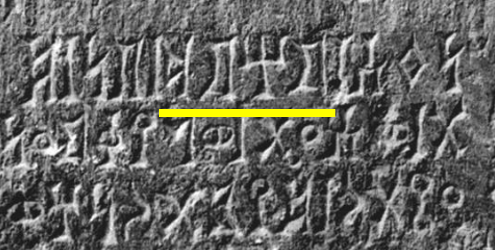
This already destroys any argument that Mhmd was not a regular human name. Jay Smith has been told about this monument. All the Muhammad mythicists know that it exists. But Jay Smith is no longer able to process new information that is contrary to the narratives he has concocted in his mind. As recently as January 22, 2026, he has gone onto a public platform to repeat the garbled and inaccurate confabulated story that he has made up for himself about “MHMD” not being recorded as a name, leading many people into false information.
Also in Old South Arabian is this inscription CIH 353:
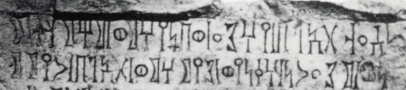
These first two lines say, “[… …] (w)-S¹ʿdtʾlb Yhs²ʿ w-bny-hmw Mḥm{|}dm / [… … b]nw Ms²ʿrn hqnyw s²ym-hmw Tʾlb Rymm,” or “[… …] and S¹ʿdtʾlb Yhs²ʿ and their sons Mḥmdm / [… …] descendants of Ms²ʿrn dedicated to their Patron Tʾlb Rymm.” Taʾlab Riyāmum is another pagan god, patron of the Sumʿay confederation of tribes. Again, all responsible historians know about this.
Ja 738 is another inscription with two forms of H-M-D as ordinary names: “Yḥmd w-ʾḫy-hw Mḥmd—
/ m w-bny-hw Ḥywʿṯtr…hqnyw / ʾlmqh-Ṯhwn-bʿl-ʾwm ṣlm” or “Yḥmd and his brother Mḥmdm and his son Ḥywʿṯtr, … dedicated / to ʾlmqh Ṯhwn, Lord of ʾwm, a statue….” ‘Almaqah was the main pagan god of Saba, and the statue is an idol.
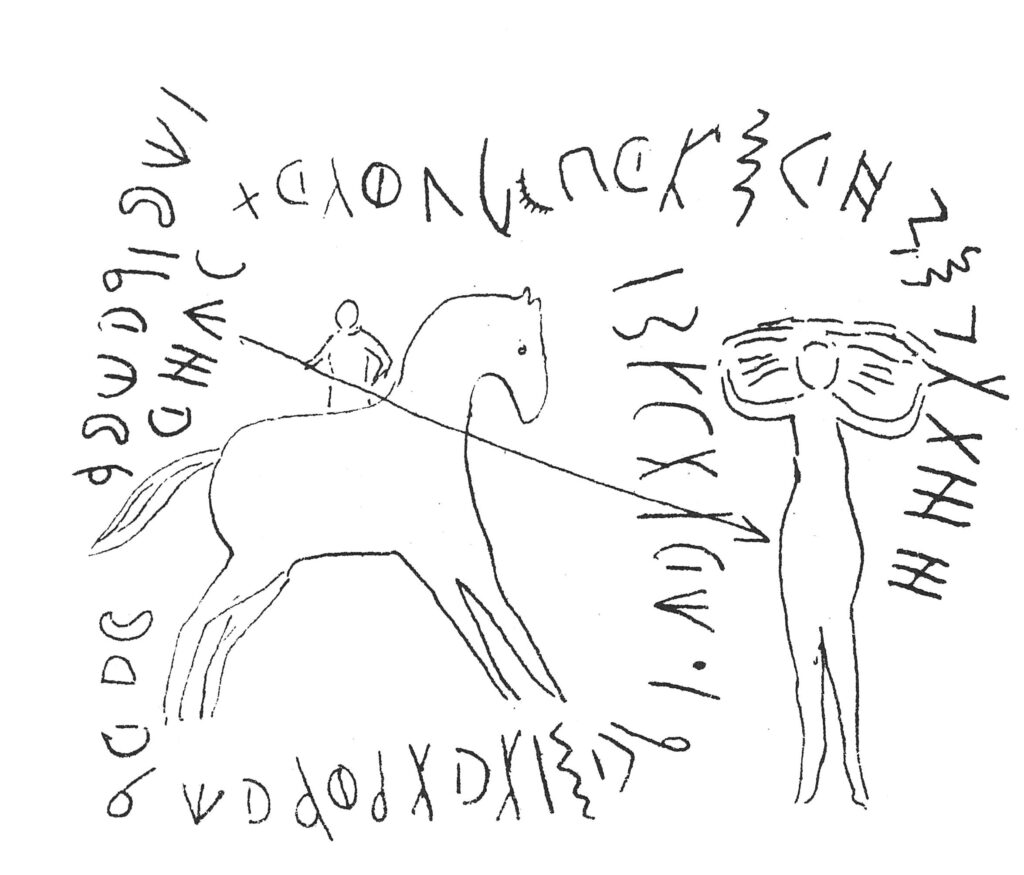
There is also this engraving:
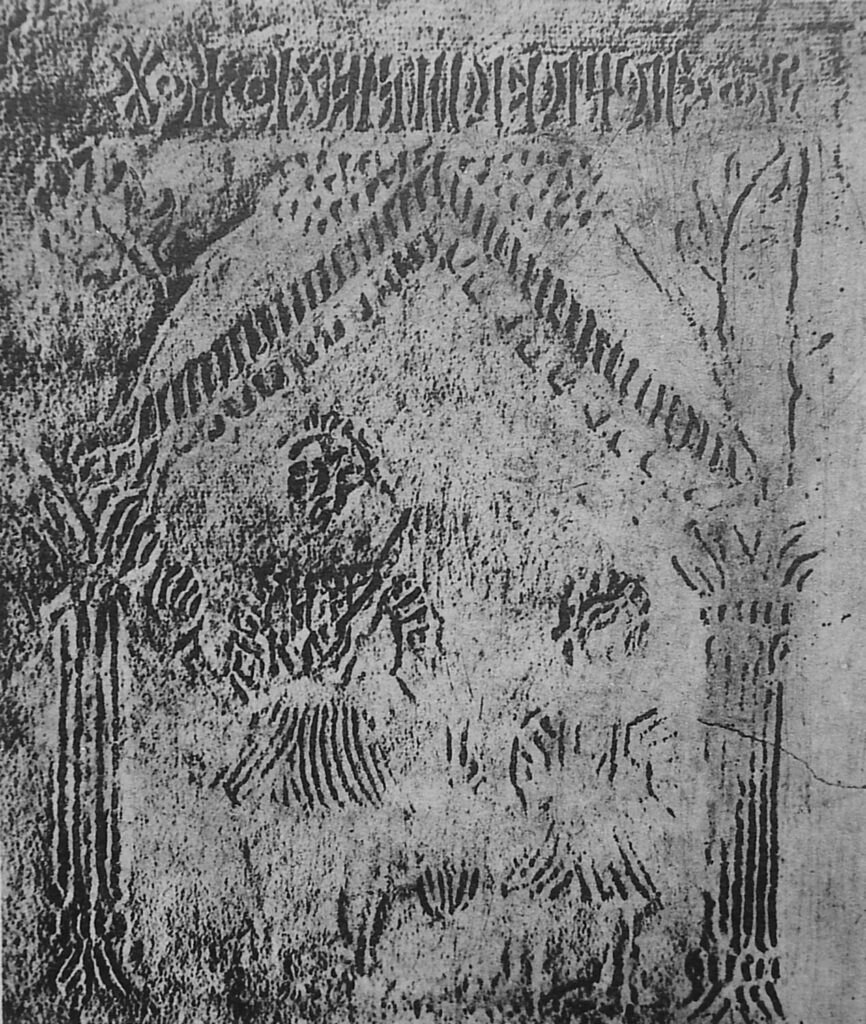
The text at top is, “ṣwr Mḥmdm bn Ws¹ʾt” or “Mḥmdm son of Ws¹ʾt fashioned (it).”
Notice that not only are this regular humans, but in most cases, they are engaged in pagan worship. This is a pagan name in a pagan context.
We also have one stand-alone inscription that simply reads “MHMD” in the pre-Islamic Modern South Arabian Dhofari 1 script, which may be a name or may be an isolated statement of praise–but cannot be a title. Unlike in Arabic or Old South Arabian, inscriptions in Modern South Arabian inscriptions often speak of praising a pagan god using the HMD root, so this could just mean “praising.”
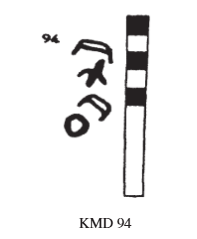
This name is also found in the female form, “Mhmda.” A woman whose name is spelled this way was listed among the Christian martyrs of Najran. These martyrs were killed in the early 6th century before Muhammad was born. Najran was an Arabic-speaking city full of Arabic speakers in northern South Arabia. This is another instance of Mhmd being used as an ordinary name for an ordinary person. Even Robert M. Kerr includes this Mhmda in his review of the use of the word as a name. Thus, anyone at all associated with Muhammad mythicism should know that Mhmd was the name of regular human beings well before Muhammad’s birth.
Islamic sources also show that Mhmd is an ordinary name, with one of Muhammad’s followers having the birth name Muhammad ibn Maslamah. Another form of this name (Mahmud) is even assigned to the elephant in the Islamic story of the Year of the Elephant attack. Even though this is a “virtuous” elephant, it seems absurd to believe that Muslims would happily accept a glorious title being given to an animal. As an ordinary name, though, it’s appropriate. Thus, they accepted that this was a regular name at the time this story was made up.
Other records survive that record the same name in a different grammatical form—not Mhmd but just Hmd, which is also attested in Safaitic (which are in early Arabic) and Taymantic (which is a close cousin to Arabic) rock inscriptions. This is also known by Robert Kerr. Hmd, too, was a regular name used for regular humans.
Yet we find Jay Smith chortling, “Muhammad…was never a name. It’s been made a name by the Muslims.” This is a stark falsehood that no one with any credibility or the most basic knowledge of the last 20 years of research would say. Jay Smith has been corrected on this many times, privately and publicly. He continues to teach falsehood because his cognitive impairment makes him unable to take corrections to his confabulated narratives. It is shameful for anyone to promote him.
Every Semitic name has a meaning
Every native name in Arabic is derived from an ordinary word. In English, we have a few names that are “just words,” like Hope, Mercy, Ruby, and Destiny. But in Arabic, all names that aren’t borrowed from another language are like this.
So every native Arabic name is a regular word that has come to be used as a name. The vast majority of these names are laudatory. This means that they say good things about the person with the name. Truthful, Fearless, Generous, Righteous, and Modest are all words that, in Arabic, are used as names.
Muhammad/MHMD, which is a native Arabic name, is no different. Like all Arabic words, it comes from a native triliteral root, H-M-D. These consonants take different forms/ They sometimes get extra grammatical consonants added to them to change the meaning. Remember Muhammad ibn Maslamah? His father’s name, Maslamah, means The One Given Peace.
What can “MHMD” mean?
H-M-D is a triliteral root natively meaning “praise” in Old South Arabian (the languages of Yemen), in Arabic, and in Modern South Arabian (the languages of Oman). It has no other meaning in these languages. That these three languages share this meaning indicates that this was the meaning in Proto-Semitic, too, the common language from which all Semitic languages descend.
A tiny bit of grammar is ahead. If it makes your eyes cross, then you can skip to the last paragraph of this section.
The doubling of a letter like in “mm” is called gemination, or “twinning,” and represents a longer sound. In Arabic, it indicates an intensification in the number of times something is done or else the degree to which something is done. It is not productive, which means that you can’t just add it to any word whenever you want, but rather some words have this intensification and some don’t. Geminated words are Form II verbs. Muhammad is geminated.
The “mu” or ”ma” prefixes are for participles. “Mu” is always added to Form II verbs for both the active and passive participle, but “ma” is added only to the passive participle of Form I, “regular,” verbs. (There are other verb forms that use an “m” prefix, but HMD doesn’t use these forms.) These prefixes are productive, meaning they can be used with any verb in the right form to make a participle. So Muhammad/MHMD must be a participle. Other Semitic languages have similar (but not identical) rules.
Arabic was originally written with only consonants and (practically) no vowels. Its writing systems also didn’t show doubled letters.
It is obvious to any speaker of Arabic that just the written consonants “MHMD” is a participle form of the HMD root. What isn’t obvious from the written form is whether the geminated Form II is meant or whether the standard Form I is meant. So there are a total of three Arabic words that can be represented by MHMD, without any diacritical marks to add more information:
- Mahmud: Form I passive participle, meaning “Praiseworthy (One)” or “Praised (One).”
- Muhammad: Form II passive participle, meaning “Many/Highly Praised (One)”—remember that the gemination is an intensification in degree or frequency.
- Muhammid: Form II active participle, meaning “(One Making) Many Praises.”
All other options are gibberish. Jay Smith claims that the Arabic can be “Makmed” or “Mahmed,” but he made this up. It’s not true. So any native speaker would know that these are the options that the written form MHMD presents.
There is no tradition that exists in any source in any language that Muhammad’s name was anything other than Muhammad his entire life. Someone can reasonably argue that he (and everyone else named MHMD) was originally named “Muhammid.” In this case, Muhammad demanded the name change which caused people to later misremember the name of his companion Muhammad ibn Maslamah and others. That is a plausible argument, though there is no evidence for it. Similarly, if for some reason you want to argue that his name was Mahmud, you could do that, too. With either argument, though, you end up in the same place: “MHMD” is an ordinary name.
“MHMD”/Muhammad in its Arabic context cannot possibly be a title
Notice in English, when we use a title, we also have to use the word “the.” For example, some people give their sons the name Loyal or Royal. These names could theoretically be used as titles, too: someone could be called “the Loyal” or “the Royal.” But we know these are just names when we see them and not titles because there is no “the” in front of them. The “the” is called the definite article. It shows that you’re talking about one particular object or person rather than an unspecified object or person. The indefinite is often shown in English with the “a”/”an” indefinite article.
Though Arabic has no indefinite article, it has exactly the same rule about titles. All Semitic languages do. To have a title in Arabic, you must have the definite article in front of it: “THE Loyal,” “THE Great,” “THE King.” This article is “al” in Arabic. Titles are extremely common in Arabic, and sometimes people are even given names that used to be titles. The “al” often drops out from these title-to-names. But it drops out because what had been a title is being used as a proper name. It’s no longer a title, so it doesn’t need the “al” any longer.
To be a title, we would need to see L-MHMD in the consonantal text. We do not. Why? Because it is not a title.
Again: Muhammad is always written without the definite article because it is not a title.
Grammar proves MHMD/Muhammad is a name
We have established that Muhammad is not a title. But as mentioned above, every Arabic native name is just an ordinary word, and “muhammad” is the Form II passive participle of the root H-M-D. Could it just be used as a regular word and not either a title or a name?
Arabic has more rules than English about requiring definite forms in certain grammatical structures. Personal names are inherently definite in Arabic just like in English and don’t ever need to have a definite article added. In Arabic, even a possessed object with a definite owner is definite. (“The cat’s mouse” is definite in Arabic as a phrase because “the cat” is definite. Similarly, “Bill’s hat” is definite because “Bill” is definite.) So if you find a word in a context where it must be definite by the rules of Arabic and it doesn’t have the article, you can know that it has to be a name or else be possessed by someone/something definite.
This is significant because some of the earliest examples of Muhammad’s name in written form are in sentences where the nouns are forced to be in the definite form. Since “Muhammad” lacks an article, it must be concluded that “Muhammad” is in the definite form because it is a name.
“Muhammad is the messenger of God” is a sentence found frequently in early Arabic inscriptions, both on coins and elsewhere, such as the Dome of the Rock. This sentence structure is called a nominal sentence. It has the structure “X is Y.” For this type of sentence, the subject must be a definite noun unless the subject forms a phrase using an adjective.
Let’s look at the Arabic: Muhammadun Rasul Allah. The “-un” part is an old fashioned version of the nominal ending “-u”, and the n being added is an old fashioned stylistic choice. Just know this means it’s the noun, the subject of the sentence. There is no linking verb in Arabic (“is” here), and Rasul Allah is definite because it’s a possessive phrase with a definite “owner” (Allah).
“Muhammadun”/MHMDN does not have an article, even though it stands alone and must be definite. What does that mean? It means that it must be a name. Not a title (which has an article), not an ordinary participle (which would have to have an article in this kind of sentence, too), but a proper name.
Trying to use exceptions
Robert Kerr is smart enough to recognize that “MHMD”/muhammad can’t be a title without an article, but he does not want the word to be a name because he is a Muhammad mythicist. It’s hard to be a Muhammad mythicist if you have to admit that Muhammad was the name of a man. So he developed arguments to try to rescue more transparently fallacious reasoning by Volker Popp and Karl-Hans Ohlig, associates in his fringe academic group INARAH that self-publishes most of their work.
The sentence “Muhammadun Rasul Allah” is a problem for him, because its structure would demand that even a regular word would have to be in the definite form for this sentence, taking the “al” even if it isn’t a title. So again, this indicates that “Muhammad” must be a name and is nothing else.
To escape this, Kerr resorts to calling on two very obscure exceptions to this rule. He raids a 19th-century grammatical work, A Grammar of the Arabic Language by William Wright and Michael Jan de Goeje, to develop his argument.
On p. 260, the authors state, “The inchoative or subject of a nominal sentence cannot, according to the Arab grammarians, consist of an indefinite noun or one which is not qualified by an adjective, or an expression equivalent to an adjective.” This is the rule explained above in simpler terms. The authors then give a list of the exceptions. The one that Kerr selects as potentially applying to this sentence is on p. 262: “when the subject is an adjective, agreeing with and taking the place of a suppressed substantive.”
To someone who doesn’t know what these words mean, it may sound authoritative that Dr. Robert M. Kerr, philologist, endorses this possibility. But if you understand what he is actually attempting to argue, you realize that it is simply nonsense.
What the authors mean is that the real subject of a sentence can be a phrase that contains a noun with an adjective. In such a phrase, the subject wouldn’t be forced to be definite. The noun part of the phrase then can sometimes get dropped and is only implied (the authors call this “suppressed”), so only the adjective is left explicit. Because the adjective is standing in for an entire phrase that has both noun and adjective, it’s allowed to avoid being forced into a definite form.
The argument is, then, that the sentence “Muhammadun Rasul Allah” really intends to mean something like “A praised prophet is the Messenger of Allah,” but the word “prophet” (or whatever is supposed to be there) is just implied, so it is written like “A praised (one) is the Messenger of Allah” instead.
There are multiple problems with this attempt to rescue the denial that MHMD is a name.
First Issue:
How is it that, in all these cases of formal writing, the actual noun for this critical phrase is conveniently implied? Leaving out the noun usually appears in writing only after the full phrase has been established. But “MHMD” never appears in a phrase as an adjective modifying any noun in any early Islamic text except for Q. 17:79, where the phrase is “a praiseworthy standing.” This is a thing (a location), not a person, and so cannot make sense of the key sentence. Thus, what it supposedly modifies is never established in any text. And it is doubly strange for the noun to only be implied or to be “suppressed,” as the grammar text puts it, in a critical stand-alone statement of faith.
Robert Spencer wrote a blistering attack on Joshua Little for pointing out the grammatical implausibility of “Muhammad” in “Muhammadun Rasul Allah” being anything other than a name on the basis of this exception, declaring that Little’s argument proves “a little knowledge is a dangerous thing.” So I asked Spencer multiple times 1) What substantive is suppressed? and 2) What evidence do you have that any suppressed substantive belongs as part of a phrase? He dodged these questions, even though they should be able to be answered in a very short sentence if the argument has any weight.
It seems that Spencer was given this argument by his friend Kerr but does not know what a “suppressed substantive” even means. If a little knowledge is a dangerous thing, then no knowledge at all is much more dangerous. It is not appropriate to rely on second-hand formulations of arguments and have confidence that they are sound merely because you like someone personally. If you don’t understand an argument, the best approach is silence.
Second Issue:
It makes no sense for the original to be something like “A praised prophet is the Messenger of Allah.” “A praised prophet????” Which one? This is a very bizarre sentence. Yet using the grammar, it can only be argued that the adjective is allowed to remain indefinite if in the “true” implied sentence, the noun phrase is properly indefinite.
There is no case in which the form can be indefinite (a praised prophet) but the meaning is really definite (the Praised Prophet). In my multiple emails with Spencer, it was extremely clear that he did not understand the implications of the noun phrase being properly indefinite and how nonsensical this makes the sentence. More on that in a moment.
Another appeal
Spencer also quotes from Kerr who quotes the grammar’s final exception for definiteness on p. 263: “in some cases in which a strong emphasis rests upon it.” In this case, surprise, disbelief, or a similar emotion in being expressed, which overrides rules requiring the definite form in various types of sentences. The examples given are “Something has brought thee!” implying that something very important has brought the person, and “An ox has spoken!”
Not only would this be implausible and bizarre for a confident statement of identity, but again, this is a case which permits the indefinite form to exist, and when the indefinite form exists, so does the indefinite meaning.
Any random praised dude?
And this is the elephant in the room. Because Kerr wants to avoid the public humiliation of making extremely basic grammatical errors, he is forced to argue that the meaning of “muhammad” in all early Islamic texts is properly indefinite. He doesn’t want it to be a name, because then Muhammad mythicism is in the waste bin. And he knows perfectly well it is not a title or another definite noun, because it doesn’t ever appear with an “al” or in a possessive structure. All that is left is to argue that it is indefinite and is really meant to be indefinite.
So for Kerr, “muhammad” necessarily means a praised one, any praised one, the praised one you saw last Wednesday talking to that other praised one in the marketplace. “Is that a praised one? Why yes, it is!” “Who’s your favorite praised one?” “Oh, it’s the guy who gave my camel a really good medication the last time he was sick.” This might be grammatically possible, but it is, on a strictly grammatical basis, completely implausible, unreasonable, and unwarranted.
But perhaps even more damningly, arguing that this “is “Muhammadan” properly indefinite is necessarily denying that it has a special and specific meaning. Since their mythicist tower of cards depends entirely on the meaning communicating unique and even esoteric specificity to its audience, the whole mess comes toppling down.
A few parallels to clarify that may be more familiar. In Hebrew, another Semitic language, HaShem is always HaShem, God being called the Name. HaMashiach is always HaMashiach, the Messiah being called the Messiah. Are there other names that are not the Name? Yes. Are there other messiahs (anointed ones) who are not the Messiah? Yes. That is why it is required to use the definite article with the noun, to be clear this isn’t some random name but God himself being referenced. Arabic is no different. Jesus is always al-Masih, the Messiah, just like in Hebrew, because the same requirement holds for both languages. In fact, you never have “a” messiah at all in the Islamic sources—al-Masih is always, without exception, the singular Jesus, and so “Masih” never fails to appear without its “al.”
Yet Kerr wants to have it both ways. He wants this to be an indefinite noun, and at the same time, he wants it to refer specially to the Messiah, because Kerr is in the Muhammad-in-early-Islamic-writing-is-Jesus/the-Messiah camp. But this is not coherent. If the word is indefinite, then it is nonspecific. A nonspecific word cannot have a narrow and specific intended meaning, and so it is disqualified an allusion to Jesus or the Messiah.
But what about Qutham?
Islamic legend wishes to make Muhammad’s name something extraordinary. But this cannot be accomplished because even the Islamic sources show it was a regular name in circulation at the time. Later sources try to deal with this by claiming that Arab parents all knew that the prophet to come would be named Muhammad and so were giving their child this special name in hopes that they would have the prophetic child. This is clearly ad hoc with no reason to believe it is true. Ironically, mythicists often get off on the wrong track because they put stock on late Islamic legends and do not pay enough attention to earlier sources.
Some Muslims and non-Muslims alike are confused by the consternation expressed by the Qurayshi in one narrative in which Muhammad’s grandfather announces his name. They pay attention to the answer, which is that this name is suitable for someone who is going to be as great as Muhammad will certainly be. But they don’t pay attention to the question, which is, “Why do you propose to keep a name that was certainly not kept by your forefathers or any of your family members?” (Search “naming” on this page.) The question is not why Muhammad is getting such and awesome name. The question is why Muhammad is being denied a family name. Why? Because this name was in circulation at this time, but it was not a name that the Quraysh used.
This event is tied to many other stories that point to Muhammad’s unknown paternity and his grandfather’s unwillingness to endorse Muhammad as his grandson in an unqualified way. There are a series of narratives set in Muhammad’s early life that have the goal of recasting historical events embarrassing to Muslims at this time into proofs of prophethood instead. Having Muhammad’s grandfather give a long monologue about the virtues of the name he had chosen over a family name fits neatly into this pattern. So do the narratives that variously claim that either Muhammad’s mother or his grandfather got a miraculous dream where they are told to change his intended name from the family name “Qutham” to the outsider’s name “Muhammad.” “It’s not that he was refused a family name,” these stories are saying. “It’s that he is so special he got a super-special name instead.”
Muhammad bolstered the idea that having a non-family name had prophetic precedent in the narrative he gave about John the Baptist in the Qur’an, in which John is given the name “Yahya” even though it isn’t a family name because he is so special. In fact, John the Baptist is chosen to be the first person ever named “Yahya” in the Qur’an. This may have primed less educated Muslims centuries later to falsely believe that Muhammad was also the first of his name.
One final wrinkle
There is one more early instance of “MHMD” in an inscription with an obscure context. On this inscription, due largely to a mistranslation, MHMD was initially interpreted as a divine name or even, more ludicrously, a divine title. This was also before all the other early instances of the name MHMD had been uncovered, and it was under the influence of Islamic folkloric claims that Muhammad’s name was special, a proof of prophethood before he was even recognized as a prophet.
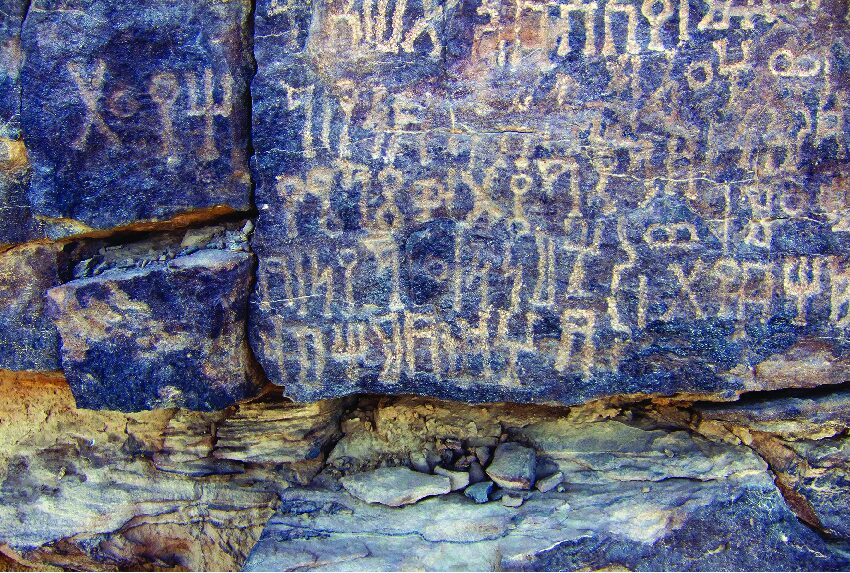
This phrase is found at the end of Ja 1028, an Old South Arabian inscription by Jewish Himyarite leaders commemorating how they slaughtered all the Christians in Najran. At the very end of the inscription is the phrase, “The Lord of the Jews, by/with MHMD.” This has recently been falsely translated as “By/with the Lord of the Jews, by/with MHMD,” which would imply that the Lord of the Jews and MHMD are parallel figures or even a renaming of the same figure. This is not what the inscription says. There is no first “by/with.” The Lord of the Jews is one individual—that is, the Jewish God. And MHMD is necessarily someone entirely different, as he is “by/with” the first figure. Note that there is not definite article for MHMD—this is a name, not a title, even here.
In Journal Asiatique, 8 serie, tome II, of January 1884, we find this observation by Halevy on p. 103 concerning this inscription:
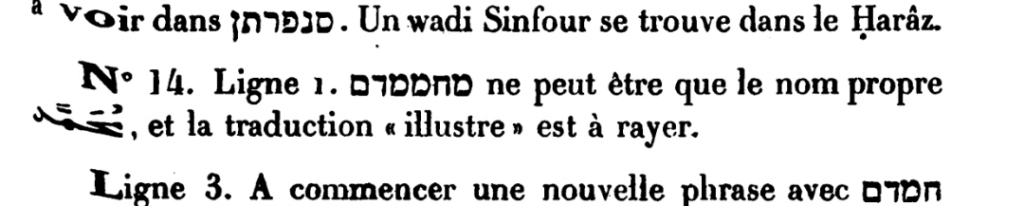
“MHM(M)D(S) cannot be other than the proper name, and the translation ‘illustrious’ is to be struck out.” So by 1884, scholars knew this was grammatically a name and could not be anything else. What is the excuse of people 150 years later who are still confused by this?
Photographs of it are extremely clear that there is not only no additional by/with but also no room for it. So the question is who first made the error in the transcription? And was it deliberate? Kerr still boldly quotes the false transcription in his work.
Having been derailed by this mistranslation and under the false impression that MHMD was a very special name, a few scholars shifted to the view that “MHMD” was a name for the Messiah instead. But these are Talmudic Jews. They did not believe in a pre-existent Messiah who could be “with God” before his birth, and the Himyarites certainly did not believe that they lived in the days when the Messiah was currently among them.
Additionally, note that “by/with” is the normal authorship preposition found in other inscriptions. The phrase follows the form of other scribal signatures found in other inscriptions, and so it may be simply renaming the scribe who was doing this writing under the blessing of the Lord of the Jews. Alternatively, the Jewish man named Mhmd may have just wanted to indicate that he was “with” his God at the time of this great slaughter of Christians.
Conclusion
We have now exhaustively explored MHMD/Muhammad in its Arabic context. Surviving writings have demonstrated that Mhmd/Muhammad was used as a name for ordinary people in the Arabic and Old South Arabian languages before the birth of Muhammad, alongside the name Hmd. No instances of Mhmd being used as a title have been found.
We have additionally shown that it is not grammatically plausible for Mhmd/Muhammad to be anything other than a name in early Islamic writings. And if spurious reasoning were granted to allow the word to be something other than a name, it could then be only an indefinite participle–a nonspecific noun, which would make it nonsensical in context. It could not refer to one special individual in this case, which blows up the entire convoluted argument Muhammad mythicists are trying to make supposing other secret identities of a specific special someone behind the name “MHMD.”
3 thoughts on “MHMD/Muhammad is not a title but is an ordinary Arabic human name”