Debunking untruths about words related to MHMD/Muhammad before Islam
Summary
Despite many corrections, Jay Smith continues to teach indefensibly false things about the word MHMD in all its variants in different Semitic languages. We have debunked his false claim that Muhammad was never a name before Islam here. We debunk his claim that it “comes from” the Ugaritic language and means “annointed” or “chosen” as well as other claims here. In this third article, we will deal with the false claims he makes about the uses of MHMD in Hebrew and Aramaic. In Hebrew, the root HMD and all words derived from it never means anything except “desirable,” and it is never used as a title or as a name. In Aramaic (and Syriac), it has the same meaning, and again, it is never used as a title and it is not used as a name until Muhammad, the founder of Islam, appears in the sources. Finally, we will debunk the most flagrantly false claim, that MHMD or Muhammad or Mahmed or Makmad or some other variant of this name was used as a title of Jewish exiliarchs.
The Semitic root H-M-D in Hebrew
In Hebrew, the meaning of “desire” is the only meaning that is associated with the HMD root in any text. It is used of things that inspire attraction. Its meaning is sometimes positive, such as the fruit trees of Eden that are “pleasing to the sight” as it is usually translated (Gen 2:9) but also in negative contexts, like the forbidden fruit that is “desirable to make one wise.”
It is also used as the word translated as “covet” in Exodus 20:17 & 34:24; Deuteronomy 5:21 & 6:25; Joshua 7:21; and Proverbs 12:12 (ESV). That is, in the Ten Commandments and elsewhere, it is the verb in the command not to covet. Jay Smith falsely claims that HMD is MHMD and is a title of Christ meaning Messiah according to Saint Ambrose when it is used in Proverbs 12:12: “Whoever is wicked MESSIAH the spoil of evildoers, but the root of the righteous bears fruit.”
H-M-D is used most often as a description of inanimate objects of high value, often booty, or is used for things to be desired when compared to such objects, such as in Chron. 20:25, Job 20:20, Psalm 19:10, 39:11, Proverbs 21:20, Isaiah 1:29, 44:9 and Daniel 10:3.
It is also used of people: in Proverbs 6:25, we find “do not desire her beauty,” and the Suffering Servant of Isaiah 53:2″has no [stately] form or majesty that we should look upon Him, nor appearance that we should be attracted to Him.” Daniel is called “beloved”/”precious”/”esteemed” of the Lord in Daniel 9:23, 10:11, and 10:19 by the angel who visits him, using this word.
It is used in three additional contexts: Sitting with delight in the shade of the beloved, who is compared to an apple tree in Song of Solomon 2:3, scoffers delighting in scoffing in Proverbs 1:22, and in Psalm 68:16: the mountain God desires to dwell in.
Jay Smith falsely claims that HMD is MHMD and is a title of Christ meaning Messiah according to Saint Ambrose when it is used in Psalm 68:16: “Why do you look with hatred, O many-peaked mountain, at the mount that God MESSIAH for his abode, yes, where the Lord will dwell forever?”
Note that in every case, without exception, the meaning is linked to some form of desire. This is a full inventory of all 28 uses of the base word. The only Messianic context for the entire list is in Isaiah 53, where the Suffering Servant is explicitly said to not be desirable.
“MHMD” in Hebrew
The form MHMD is written מַחְמָד in vocalized Hebrew. It is transliterated machmad and pronounced Makh-MAHD in the conventional dialect that became modern Hebrew. There are 12 occurrences of this form in the Old Testament. All of these relate to desire, once again, and this form is considered to be emphatic: very desirable or most desirable, or, by extension, precious or beloved.
In every case, machmad is an ordinary word, either a noun or an adjective, which is is used to mean desire/desirable. There is absolutely no basis for the claim that it literally means “chosen” or “anointed” in any text in any language, including Hebrew.
Eleven of the 12 occurrences are in the context of terrible things happening to beloved objects, a beloved place, or to beloved people (family members). Not one is even glancingly Messianic. Quotes are from ESV.
1 Kings 20:5-6: Thus says Ben-hadad: ‘I sent to you, saying, “Deliver to me your silver and your gold, your wives and your children. Nevertheless I will send my servants to you tomorrow about this time, and they shall search your house and the houses of your servants and lay hands on whatever pleases you and take it away.’”
2 Chronicles 36:19: And they burned the house of God and broke down the wall of Jerusalem and burned all its palaces with fire and destroyed all its precious vessels.
Isaiah 64:11: Our holy and beautiful house, where our fathers praised you, has been burned by fire, and all our pleasant places have become ruins.
Lamentations 1:10: The enemy has stretched out his hands over all her precious things; for she has seen the nations enter her sanctuary, those whom you forbade to enter your congregation.
Lamentations 2:4: He has bent his bow like an enemy, with his right hand set like a foe; and he has killed all who were delightful in our eyes in the tent of the daughter of Zion; he has poured out his fury like fire.
Ezekiel 24:16: “Son of man, behold, I am about to take the delight of your eyes away from you at a stroke; yet you shall not mourn or weep, nor shall your tears run down.” (This is Ezekiel’s wife.)
Ezekiel 24:21: ‘Say to the house of Israel, Thus says the Lord GOD: Behold, I will profane my sanctuary, the pride of your power, the delight of your eyes, and the yearning of your soul, and your sons and your daughters whom you left behind shall fall by the sword.’
Ezekiel 24:25: “As for you, son of man, surely on the day when I take from them their stronghold, their joy and glory, the delight of their eyes and their soul’s desire, and also their sons and daughters,”
Hosea 9:6: For behold, they are going away from destruction; but Egypt shall gather them; Memphis shall bury them. Nettles shall possess their precious things of silver; thorns shall be in their tents.
Hosea 9:16: Ephraim is stricken; their root is dried up; they shall bear no fruit. Even though they give birth, I will put their beloved children to death.
Joel 3:5: For you have taken my silver and my gold, and have carried my rich treasures into your temples.
With this background, let us look at the only place where this word is not associated with destruction, death, loss, and plunder: Song of Solomon 5:16. In this text, the Shulamite is describing the Beloved’s body. Here is this entire section for context:
10 My beloved is radiant and ruddy, distinguished among ten thousand.
11 His head is the finest gold; his locks are wavy, black as a raven.
12 His eyes are like doves beside streams of water, bathed in milk, sitting beside a full pool.
13 His cheeks are like beds of spices, mounds of sweet-smelling herbs. His lips are lilies, dripping liquid myrrh.
14 His arms are rods of gold, set with jewels. His body is polished ivory, bedecked with sapphires.
15 His legs are alabaster columns, set on bases of gold. His appearance is like Lebanon,
choice as the cedars.
16 His mouth is most sweet, and he is altogether desirable. This is my beloved and this is my friend, O daughters of Jerusalem.
This simply one word in a long description of the Beloved, with no more or less emphasis than any other word. Because of Hebrew grammar, it is a noun–but it is plural. He is “complete desirablenesses.” Hebrew uses plurals for mass nouns to emphasize extent–in this case, the desirableness itself has great extent. It cannot grammatically be a title of a single person, nor is it used with any emphasis over the other items in this descriptive list.
Jay Smith makes the false claim that “every Hebrew scholar knows the Makmed/MHMD that’s referred to, the altogether lovely one, is known as the anointed one.” I challenge Jay Smith to name one Hebrew scholar who has ever said that the word “machmadim” in this verse is “the anointed one”–even that this word can plausibly be used as a title in any context.
This is the full inventory of all instances of machmad in Hebrew. It is never used in any other recorded text. Not as a name. Not as a title. Not as anything. And never with any other meaning.
If a typological view of Song of Solomon is taken and Christ is taken to be the Beloved, then the descriptive word of “desirable” is applied to Christ’s body. This was, in fact, a common view of the Fathers. Yet every word used to describe Christ does not become a title for him, much less this one word in a long passage. And if you are an educated Christian, you will realize what it would mean for Christ’s body to have a description: the Body of Christ is typologically the Church, not Jesus. And indeed, in every case, the Fathers do not see this passage as describing Christ himself but to describe the Body of Christ–the believer individually or the church collectively. Thus, they do not even apply the word to Jesus himself in even a single instance.
There will be a full article on the false claims surrounding this single verse made by Jay Smith through his most important collaborator, a monolingual Irish public school teacher named Mel who has no training or skill in historical research. Despite his background as a teacher meaning that he should know basic standard of academic integrity, Mel provokes AI hallucinations to try to support his claims, believes them, and feeds them to Jay Smith while hiding that the origin was AI. When called out, Mel complains that it takes too much time to do the research to find out whether an AI result is hallucinated or not and insists that AI can’t be wrong and instead is summarizing texts or is correctly giving words that a Father would have said, even though he didn’t. Mel is the man whom Jay Smith calls a “historian” and an expert on the history of Islam, who is far above the caliber of all his critics.
Predictably, Jay Smith still, to this day, shamelessly utilizes these AI hallucinations to claim that “machmad” is a title meaning Anointed One. But the greatest irony is that even the AI hallucinations Mel has provided him, though entirely false, do not even support this conclusion. Though Mel manipulated the AI, he couldn’t ever get it to hallucinate the kind of text he really wanted! Mel and Jay Smith go from AI hallucinations that ascribe to various Fathers the opinion that “lovely” is a mere description of Christ to the claim that they make up on their own that this word was a title of Christ and that it has the literal meaning of Chosen One and Anointed One/Messiah. If “gold head” from the same list is not a “title of Christ,” why would “altogether desirable” be considered one? It is sheer and flagrant invention, with a profound disrespect for the Word of God. This is a brazen level of academic dishonesty, and it is outrageously unacceptable for a professed Christian to be doing this.
“HMD” only means “desire” in Aramaic and Syriac texts
Syriacists have compiled the Comprehensive Aramaic Lexicon Project, which seeks to compile every single Aramaic or Syriac text and index each word in every text, from the 9th century BC to the 13th century AD. The database currently contains 3 million indexed words. Though it is not complete yet, it contains vast amounts of the amount of surviving text in Aramaic/Syriac, and it has an index which allow you to find every instance of a word in its context and its definitions.
Here are the head words for HMD:
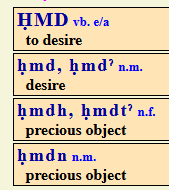
For the first entry, the definition is a verb, “to desire,” and here are the citations:
- Targum Jonathan for Zephaniah 2:1 “the generation that did not desire to return to the Law”. (For an explanation of what a targum is, see here.)
- M. Sokoloff and J. Yahalom, Jewish Palestinian Aramaic Poetry from Late Antiquity (Jerusalem:
Israel Academy of Sciences and Humanities, 1999).: O one from the loins of Hamdata, you desired the nation but were thrown into prison. - Cairo Geniza mss. of the Palestinian Targum to the Pentateuch for Exodus 20:2: ” I desired you more than any nation.”
- Samaritan Targum Jonathan for Exodus 20:13, as an expansion on “You shall not murder” (translation not given).
- Targum Pseudo-Jonathan on Deut. 7:25: do not desire the silver and gold that is on them.’; on Genesis 4:1: she desired the angel, conceived, and bore Cain.; on Genesis 49:26: my fathers Abraham and Isaac whom the chieftains of the world envied. Genesis 31:30, untranslated, but the verse is “Now you have gone off because you longed to return to your father’s household. But why did you steal my gods?”; Genesis 28:12, untranslated, but the original verse is, “ He had a dream in which he saw a stairway resting on the earth, with its top reaching to heaven, and the angels of God were ascending and descending on it.”
- The Genesis Apocryphon from Quran Cave 1, 20.5: how … and desirable is the entire appearance of her hands.
- Targum Onqelos Exodus 20:17, variant, and also Deut. 5:21: untranslated, but the verse is in both cases the command not to covet.; Genesis 31:30, also untranslated, but the verse is “Now you have gone off because you longed to return to your father’s household. But why did you steal my gods?”
- Palestinian Talmudic Tractate 66.d:5[2]: he was patient, desiring to hear her talk.
- Targum Neofiti on Genesis 28:10: for the divine word desired to speak to him.
- Christa Mueller-Kessler and Michael Sokoloff, A Corpus of Christian Palestianian Aramaic, Vol. III: The Forty Martyrs of the Sinai Desert, Eulogios, The Stone-Cutter, and Anastasia, Groningen: STYX, 1996.: I was desiring to pray and worship the Lord of the Cross.
- Tibat Marque: all these were wanting to see them and desiring to meet with them.
The second head word contains the following:
- Christian Palestinian Aramaic translation of Deut 12:21: you may eat in your cities according to your soul’s desire
- Babylonian Talmud Tractate Shab. 152a(44): PN’s sexual desire ceased.
The third cites this:
- Targum Jonathan on Isaiah 32:12: precious fields; Joel 4:5, untranslated, but the original verse is “You took my silver and my gold and brought my priceless treasures into your temples!”
For the fourth, we find this:
- Targum Neofiti on Genesis 50:1: Untranslated, but the original verse is “Joseph threw himself on his father and wept over him and kissed him. Then Joseph directed the physicians in his service to embalm his father Israel.”
Notice how not one source has a meaning other than “desire” or “desirable”–even envy is linked to this through coveting, a meaning of the root word. To emphasize yet again: Any claim that MHMD, Muhammad, Mahmed, Makmed, or Machmad means “praised one” or “chosen one” or “anointed one” is sheer deception.
“MHMD” means only desire in Aramaic and Syriac texts
While words with the “hmd” root are fairly common in their basic meaning of “desire,” the form MHMD is so rare that it has only been documented once, in the Geonic Responsa, a Jewish rabbinical text. In TGHark(1) 27.1.10 we find, מחמדי עיננא the desires of our eyes.
A machine translation places this as the description of a question–these were the most precious questions asked of them: “This is the matter that Mar said, Nahshon Gaon was like a high mountain; and they perform in it a constant deed in all the courts of law, and there is no refutation against it. The questions that were asked of us, the desire of our eyes, Rabbi Nehemiah bar Rabbi Ovadiah and Rabbi Moshe bar Rabbi Samuel bar Ga’ame are remembered for peace; and the rabbis and students who are in the lands of Qabes from the western….”
Note that the “the,” the article, only appears in English and is not part of the Aramaic. This cannot possibly be twisted into a grammatical title.
Jay Smith’s thesis that this was a “title” meaning anything, much less “Anointed One” or “Messiah” is entirely without merit. Not only is it not a title, but the word is hardly even in use. Out of more than three million words of representative text, this word only appears one time in a completely unrelated context. It is not tenable that a word that practically no one is using is a “well-known title,” yet this is the claim of Jay Smith.
It is worth repeating: Any claim that MHMD, Muhammad, Mahmed, Makmed, or Machmad means “praised one” or “chosen one” or “anointed one” or refers to Jesus Christ is sheer deception. How should Christians view those who choose to deceive others about Christ?
Syriac/Aramaic speakers did not all think Muhammad’s name even had the consonants “MHMD”
The theory that the word spelled “MHMD” in Arabic is connected to Jesus through Aramaic is already debunked by the simple fact that MHMD is never used as a title for anyone and also never used in reference to the Messiah generally or Jesus specifically in Hebrew or Aramaic. Not by Christians. Not by Jews. Not by pagans.
But even more damning is that when Syriac speakers heard Arabs say the name of the person whom they followed, they didn’t even always hear the word “MHMD.” (Some dialects of Aramaic are called Syriac. When we speak of Aramaic in the time of Muhammad, the dialect is almost always one called Syriac.) Each of these letter are critical for the identification of the word, but most especially the letters that make up the triliteral root: HMD. It is entirely ludicrous to suppose that any Aramaic speaker could hear different consonants and still believe the word to be MHMD and thus refer to Jesus (whom they never even called MHMD!).
Yet we find it common for Syriac speakers writing “T” for the “D,” yielding the nonsense root H-M-T. Again, H-M-T yields words without meaning. Why did they write it this way? Because the Syriac-speaking listeners did not register the name as they heard it as being equivalent to anything in their native language.
Thomas the Presbyter is one of the earliest sources, and he wrote “Mhmt.” The Chronica Minora III likewise reads “Mhmt.” The Continuatio Byzantia Arabica has, as its base, a Syrian chronicle translated into Latin, where Muhammad’s name is rendered “Mahmet.” The chronicle Ad Annum 705 gives “Mhmt.” The chronicle Ad Ammum 775 gives “Mhmt.”
Some texts that have MHMD add a vocalization that makes it clear that the word is Arabic, not Syriac: the Fragment on the Arab Conquest of Syria called him “Mwhmd,” that is, “Muhmd.” This can realistically only represent Muhammad, using the mater lectionis for the U, the purpose possibly being to avoid confusion with the Syriac word with the consonants MHMD. We also find this spelling in another 7th century text, A Monk of Beth lfale and an Arab Notable.
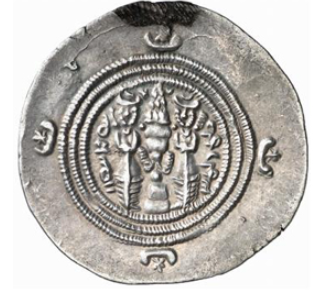
In Persian, too, we see the D swapped for a T in multiple coins beginning in AD 689: MHMT PGTAMI Y DAT. Keep in mind that Persia had many Syriac speakers, and so if they understood this as an Aramaic title, the Persian transcription would have almost certainly been represented correctly with a “D.”
It is extremely bizarre that Jay Smith attempts to call the Greek texts as his witnesses that the word is properly Aramaic in meaning rather than the Arabic word Muhammad. This seems to be based on the number of syllables Jay believes are in the earliest works. But some Greek transcriptions of the name represent two syllables, while others represent three: Mamed and Mamet are two, but Maamed and Maamet are three, leaving out the “h” which is often skipped in Semitic-to-Greek transcriptions, just as Rahab’s name is written “Raab” in the Biblical book of James. Literally any Greek speaker will inform you of this convention–the rough h in the Arabic can either be heard as a breathy h, in which case it is skipped, or as a chi (χ), in which case it is represented. No breathy h is ever represented in Greek writing.
Not only are the number of syllables inconsistent, but more importantly, the final letter is also inconsistent. There is simply no knowledge shown in the early sources that this name corresponds to “MHMD” in Aramaic, but Jay insists that “the Fathers” writing in Greek called Jesus “machmad” or “mahmed” or “mamed” or some such word, or at minimum that Greeks would understand the word as a Messianic title. This has no philological basis whatsoever, nor is there any support for it in any historical work in any language.
The final consonant is consistently “T” in all two-syllable Coptic variants, too. Only when the three syllable Mōhammēd appears do we get a “D.” In one version of the Armenian Pseudo-Sebeos text, also, it is reported that we have Mahmet. (In the manuscript I found online, it was the three-syllable “Muhammad.”)
Of all appearances of Muhammad’s name in the thirteen surviving “Latin Lives” of Muhammad, which are from the 9th to 13th century, 12 have three syllables (ignoring any final -us) and only one has two syllables. Eleven end with “T,” one with “TH” and one with “D.” And the single two-syllable name ends with “T.” The influence of this “T” brought from Syriac speakers and Syriac-contact Greek speakers to Latin was so evident that Muhammad’s name still ends with a “T” in many European languages, as it was “Mahomet” in English until the 20th century.
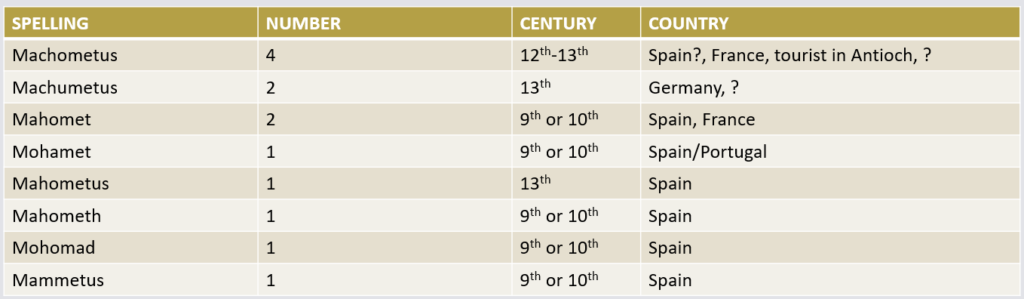
It is quite possible that Syriac speakers often simplified his name to “Mahmet,” fitting with a more comfortable Syriac vocalization pattern that was picked up by other Christian groups. But “Mahmet,” though easy to say in Syriac, has no Syriac meaning whatsoever. It is a foreign word for them, changed in the way that English speakers change “matre d'” to “mayter dee”–to something more comfortable to say, according to our understanding of what the sounds are, with no attempt to make it parallel to a meaning in our own language.
Nor does a missing syllable indicate that the name was not the Arabic Muhammad! To this day, Mehmet and Mehmed are the Turkish versions of Muhammad, and the name was, without any doubt, as much “Muhammad” when the Turks first conquered Muslim lands around AD 1300 as it is today.
Jay Smith endorses fringe anti-Christian Jewish propaganists
The claim that “Muhammad” or “MHMD” is a title used by Jewish exilarchs is adopted by Jay Smith exclusively from A. J. Deus, the pseudonym of a person who self-publishes propaganda on academia.edu. It is critically important to understand who this person is and what he stands for. Jay Smith has gotten information about Deus via Mel of Islamic Origins. Jay Smith calls A. J. Deus Mel’s “good friend.” So already, we are a telephone game step away from the sources. Jay Smith then adds his own obfuscations to the mix, which we will explore at the end of this article.
Deus’ meaningful claims are all assertions with no foundation or support of any kind, and it is the worst kind of anti-Christian propaganda. The following statement he makes about Nicaea I in “The Umayyad Dynasty’s Conversion to Islam – From the Low Point Until ca. 692 AD” is his most important claim, because this is his driving framework. Everything he says about Islam is to back up these claims about early Christianity.
“There is another problem with Nicea [sic]: only seven representatives of the new creed of Jesus being God had miraculously outvoted three hundred representatives of the widely accepted old creed of Jesus being a human rebel on a mission to redeem Israel. Henceforth, Bishop Arius’s defense of the ancient beliefs was treated as if it constituted an innovation.” (Source)
All of this is simply a lie. Nicaea’s vote was unanimous on the creed, and the emergence of Arius’ novel invented doctrine is clearly documented within the context of an overreaction to the earlier Sabellian heresy. Nor was Arius ever a bishop!
Yet Jay Smith endorses A. J. Deus as a scholar. His intimate collaborator Mel actively platforms him. Does Jay Smith believe, as Deus claims, that before Nicaea, virtually all Christians denied that Jesus was God? Does Jay Smith believe that the Qur’an accurately reflects the historic faith in denying that Jesus is the Son of God? Why does Jay Smith choose to promote invented propaganda that is meant to corroborate this thesis?
While Deus often pretends that his claims might be construed to be “anti-Semitic,” in reality, they reflect a fundamentally Jewish outlook (if a fringe one), together with an anti-Christian preoccupation. There is nothing in his work that is antagonistic toward Judaism. Quite the reverse: he seeks to delegitimize the Christian orthodoxy as a recent invention that he claims usurped the authentic faith that Jesus was merely a prophet and rabbi, transforming the “real Christians” into another post-second-temple rabbinical sect. A.J. Deus is dishonestly deceiving people about his Jewish religious affiliation to promote these theories.
This is not the first actively anti-Christian fringe-Jewish-group-affiliated man seeking to use Islam to undermine Christian faith who has been platformed and supported by Mel of Islamic Origins and, because of him, by Jay Smith. Jay Smith introduced a man named “Joe” who went by the name “Red Judaism” to a wider Christian audience and actively promoted him. Why? Jay Smith was enamored with Joe’s bizarre and unsubstantiated theories about Islam, despite warnings from Christians about him and despite the fact that his ideas were transparently anti-Christian polemics. “Joe” became Mel’s main collaborator and most trusted friend until everything that Mel and Jay had been warned about proved true. “Joe’s” main purpose was to act as a proselyte for Noahidism for the goyim, to encourage Christians to deny Jesus Christ as God incarnate and turn from the faith, and he achieved a certain success because of the gullible audience that Jay cultivates. The fallout was so bad that Mel lost his original channel, Sneaker’s Corner, as part of this. Yet Mel has learned nothing since then and now has become devoted to giving “Deus” a wider audience in his place. Both Mel and Jay Smith fundamentally lack discernment and wisdom.
To emphasize: A.J. Deus is trying to make niche theories of his peculiar Jewish sect mainstream to undermine the faith of gullible Christians. He hides his own Jewish affiliation and couches wild inventions as “research.” These ideas appear to have mostly originated with two men. One is rabbi called Joseph E. Katz of Brooklyn, who calls himself a Middle Eastern Political and Religious History Analyst. The other Jewish man is named Ben Abrahamson, the Director of the Alsadiqin Institute, the purpose of which is to disseminate their fraudulent history to Muslims to change Islam into a Judaized religion in the name of “restoration.” The narrative they champion is also entirely outside the mainstream of normative Jewish history. To be clear: they make claims about Jewish history that no major Jewish sect endorses. Mel of Islamic Origins even knows about Abrahamson, and yet he still platforms this nonsense. He believes that Abrahamson is some unrelated third party who coincidentally made up the same narrative as A.J. Deus and is a corroboration that his work is solid!
One of their essays with many of their peculiar claims can be downloaded from here. This provides the basis for some of Deus’ stranger claims. The rest can be found on the Alsadiqin Institute site. Among other things, Deus’ sect believes that the Sadducees not only survived the destruction of the Second Temple in AD 70, but they were a dominant and enduring political force, especially in Tiberias, the location that the Jerusalem Talmud is traditionally held to be compiled by men who lived, died, and worked there.
This context is important for understanding what kind of source Jay Smith is using as an expert in his claim that there were many different “muhammads” or “Mehmeds” or “makmeds” or “MHMDs” in the historical sources.
MHMD / Muhammad / Mahmed / Makmad was never a title of any “Jewish exilarch” or anyone else
In this article, we will focus on only the segment of Deus’ crockpottery that Jay Smith has devoted himself to promoting: that there was a string of men called “Muhammad” who were Jewish exilarchs and also the earliest Islamic rulers.
A. J. Deus presents this thesis in his essay, “The Koran: Ants Move to Ramlah.” The attribution of “muhammad” to these figures is uniquely his. In everything thing else–the messianic line, the idea that early caliphs were Jewish exilarchs–he follow Abrahamson. In this article, Deus states that Mar Zutra II had the title “muhammad” and the proof is in a Sabaic inscription done by Yusuf As’ar Yath’ar, whose name he mixes up with his Arabic nickname Dhu Nuwas, “the curly-haired.” What he claims is this:
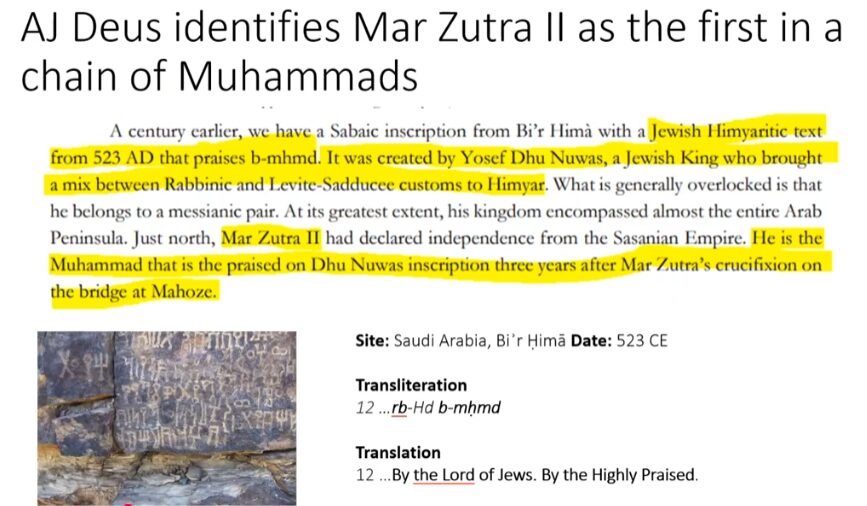
“[W]e have a Sabaic inscription from Bi’r Himà with a Jewish Himyaritic text from 523 AD that praises b-mhmd. It was created by Yosef Dhu Nuwas, a Jewish King who brought a mix between Rabbinic and Levite-Sadducee customs to Himyar. What is generally overlocked is that he belongs to a messianic pair. At its greatest extent, his kingdom encompassed almost the entire Arab Peninsula. Just north, Mar Zutra II had declared independence from the Sasanian Empire. He is the Muhammad that is the praised on Dhu Nuwas inscription three years after Mar Zutra’s crucifixion on the bridge at Mahoze” (p. 22).
This is nothing but made up nonsense. The Bir Hima inscriptions is Ja 1028, the inscription that details the slaughter of Christians. This is the end portion of the inscription, where those who erect it call on their god:
“May the Raḥmān bless their sons S²rḥbʾl Ykml[the general] and Hʿnʾs¹ʾr, the sons of Lḥyʿt and Lḥyʿt Yrḫm, the son of S¹myfʿ, and Mrṯdʾln Ymgd, the son of S²rḥʾl, of the clan of Yzʾn. The month of Mḏrʾnof the six hundred thirty-three [AD 523]. For the protection of the heavens and the earth and of the strength of the men was this inscription against those who would harm and degrade. May the Raḥmān, the Highest, protect it against all those who would degrade. This inscription was placed, written, executed in the name of the Raḥmān. Tmm of Ḥḍyt placed. The Lord of Jews. By Mḥmd.“
Instantly, we see a profound incompetence in Deus’ work. Deus wrote that there is a “text from 523 AD that praises b-mhmd.” Firstly, “b-mhmd” includes the preposition “by.” The name is just “mhmd.” And secondly, there is no praise for him. His name is simply mentioned at the end of a long inscription about killing Christians. His name means praise, but he receives none here.
There is no context of who this “mhmd” is in the inscription. But A.J. Deus simply makes up a story: “[Mar Zutra II] is the Muhammad that is the praised on Dhu Nuwas inscription.” He does not argue toward this point with evidence. He presents this inscription as the evidence. This is the underlying support for Deus’ entire thesis that Muhammad was a title: the name appears on this inscription, and because Yusuf As’ar Yath’ar was a Jewish king and Mar Zutra II happened to be a Jewish rebel who was killed a few years before hundreds of miles away, King Yusuf must have meant him by this isolated name showing up on this monument. Mar Zutra II was never called a “messiah” in any source, much less “mhmd.”
Again, this is not even an argument. It is a hallucination. The name “mhmd” shows up on a Jewish inscription in South Arabia. Deus makes up the claim that it refers to a particular person in Persia because he was also Jewish. But Mel of Islamic Origins happily presents this to Jay Smith and Jay Smith, now down another step in the telephone game, reinterprets and presents to his Christian audience. Here is Mel’s slide, complete with an errant translation of the inscription (adding words that are not in the text and turning a name into a title):
Deus then declares that Yusuf As’ar Yath’ar is a cousin of Mar Zutra II, being a descendant of Mar Zutra I (p. 22). For this, he is working from the imaginations of Abrahamson and Katz, who seem to have invented this claim here. There is no historic support for this claim: quite the reverse, as the Himyarite kings are held to be native South Arabians of the noble house who were converts to Judaism.
Deus then claims that Nehemiah ben Husheil is another Muhammad of this Zutran line (p. 22). Very briefly, this man is considered a semi-legendary figure who is called the leader of the Jewish rebels who seized Jerusalem during part of the Persian conquest and occupation of the city. He is attested to only in apocalyptic and poetic Jewish sources that are not in the most well-preserved forms, so some historians doubt he existed. But assuming that he did exist (as I tend to do), these sources have our only knowledge of him. He is, at least, called a messiah in these (unlike Mar Zutra II), but his is never called a Muhammad or a “mhmd” in any source.
The assertion that he has a Zutran lineage contradicts the only 7th century sources that mention him. The most detailed source is Sefer Zerubbabel. This is an apocalypse and so is not attempting to be a linear history, but it gives his description and lineage: “‘Concealed [in Tiberias] … is a man whose name is Nehemiah ben Hushiel ben Ephraim ben Joseph.’ Zerubbabel spoke up and said to Metatron and to Michael (sic) the prince: ‘My lord, I want you to tell me when the Messiah of the Lord will come and what will happen after all this!’ He said to me, ‘The Lord’s Messiah—Nehemiah ben Hushiel—will come five years after Hephsibah.” So according to this source, Nehemiah ben Hushiel is the Messiah ben Joseph, descended from Joseph through Ephraim. The Sefer later even calls him “the Messiah of the lineage of Joseph.” Therefore, we know three things about Nehemiah’s background from this source: his father is Hushiel, he is from the half-tribe of Ephraim, and he is living in Tiberias, the center of Judaism in the Roman province of Palestine. Other 7th century sources give nothing in addition to this.
So naturally, Deus and Abrahamson make up the claim that Hushiel is an unattested Zutran exilarch of Persia, which gives him an entirely different paternal line. Note that the posthumous son of Mar Zutra II, Mar Zutra III, did not have a recorded descendant named Hushiel, and the claim that Hushiel was an exilarch appointed by Khosrow II is a mere speculation of Frank Meir Loewenberg without any documentary support. The Zutrans were Davidic, and so a “Messiah” from a Zutran could not be a Messiah ben Joseph, as Nehemiah is called in the 7th century sources, but would have to be the Messiah ben David–which the Sefer explicitly says Nehemiah is not. This is the worst sort of nonsense.
Here is Mel of Islamic Origins teaching this to Jay Smith, who adopts it as received truth.
Deus, following Abrahamson again, also makes the wild claim that Muhammad’s companion Salman al-Farsi was actually another brother of Nehemiah named Salman ben Hushiel (p. 22). In Ibn Ishaq, Salman says that he was a Magian, using the Arabic word for Zoroastrian, and specifically speaks of fire worship in the temple. But does this stop Deus and Abrahamson from changing his religion, his lineage, and his ethnicity? Of course not. Shamelessly, they propose that rather than “al-Farsi,” “the Persian,” his epithet was really “al-Farisi,” the Pharisee–though of course this term is anachronistic by centuries at this point. Abrahamson relies on Ibn Ishaq and claims that “Magian” magically means “Jewish” and by the Persian term for a member of the landed gentry, Dihqan, he really meant “exilarch”(!!!). Later in Deus’ article, he claims that Salman the Persian is the same person as the Caliph Uthman, claiming that this identity is concealed within the document called the Doctrina Jacobi. There is no evidence for any of this. No evidence that Salman was ever called a “messiah.” No evidence that he was ever called a “muhammad” or a “mhmd.” Just fabrications presented as facts.
Does Jay Smith eagerly accept all of this from Mel of Islamic Origins? Of course, right here.
Here is Mel’s slide cheerfully presenting this nonsense lineage as if it has merit:
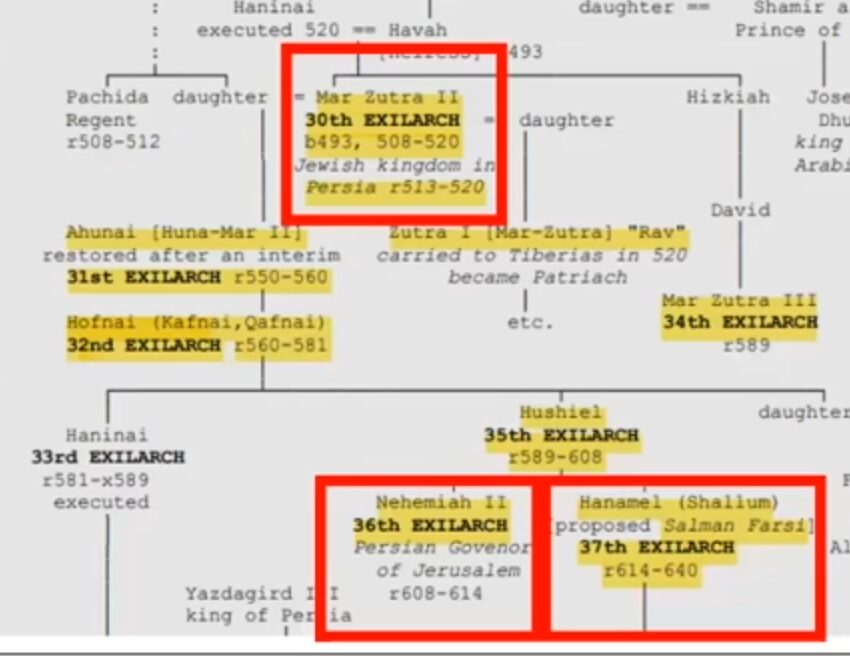
Mel of Islamic Origins is so brazen that he says, “it is actually very similar to Salmon al-Farsi which you find in the standard Islamic narrative who was an associate of Muhammad but here in the actual historical record we have an exilarch associated with the conquest of Jerusalem who the Jews would probably considered another Messiah.” To emphasize: Deus’ inventions count as “the actual historical record,” in which he makes up the story that Salman al-Farsi is really an exilarch, but the “standard Islamic narrative” consisting of actual written historical records is not. Mel only objects to Salman al-Farsi being Uthman because he has his own preferred alternative conspiracy theory candidate for the role.
Deus’ next “muhammad” is a supposed son of Salman al-Farsi, for whom he makes up the name Yaakov and claims is Ka’b al-Abhar. Salman is sometimes said to have the kunya Abu Abdullah or to have a son named Muhammad, but there is nothing recorded of any children, so it seems that he had no children who survived to adulthood. Ka’b al-Ahbar is an entirely unrelated person, a native Arab Jew from Yemen who converted to Islam after the conquest of Yemen and became prominent as one of the very few Jewish converts. There is no story that claims he was born to a sahabi or had any familial relationship with Salman al-Farsi whatsoever. Of course, he is never called a Muhammad/mhmd or a messiah, either. Does this stop Deus from making this up? Of course not. But his argument is more insane than this. He claims that Ka’b went to the academy of Pumbedita, the center for Jews in Iraq, which Deus in another place falsely claims is in the same place as Baghdad while citing a source that very clearly says that it is not located there. But Deus gets more insane. He claims that this Ka’b is the same person as Abu Bakr, the caliph. The proof of this is that he is the same person as the Jewish merchant in North Africa who is a forced convert to Christianity called Jacob in the document called Doctrina Jacobi. Yes, this is just as much nonsense as it sounds.
Even Mel is slightly embarrassed about this, as if some small part of his brain is realizing how stupid it sounds as he says it. But he says it anyway, and Jay Smith sits and listens to it.
Deus makes up a fifth messiah/Muhammad/mhmd (still p. 22), a second son for Salman, whom he names Heman. This, too, comes from Abrahamson. Deus and Abrahamson make up the idea that Salman was the father of Abdullah ibn Salaam, Muhammad’s only Jewish convert in Medina before he started killing Jews who wouldn’t follow him. Abdullah’s pre-Islamic name was actually Al-Husayn ibn Salaam. He was an adult fieldworker with a family from the Qaynuqa tribe of Medina, who claimed descent from Joseph–not David, and certainly no relation to Salman. Presumably, because “Salaam” and “Salman” ultimately have the same root, Abrahamson and therefore Deus feel entitled to simply declare that they are the same person. There is no support for this. They also claim he is the same person as Abdullah ibn Saba’, an obscure Himyarite Jew from Yemen who converted to Islam only during Uthman’s reign. For some reason, Deus makes up the claim that this person was associated with al-Aqsa mosque, which he arbitrarily called “Masjid as-Salman,” which was not ever its name. And not content with this, he declares that this same person is also the Qurayshi Abdullah ibn al-Zubayr. Then he declares that this person was also a messiah/muhammad/mhmd. There is nothing to say about this. It is all made up nonsense.
Mel rejects the identification with al-Zubayr (again, because he has his own theories) but happily accepts that this “Heman”/Abdullah ibn Salaam is a son of Salman the Persian.
On the next page, A.J. Deus sums up his position:
“It is easy to understand, and I say it in plain English without further elaboration: The Mar Zutra linage [sic] carries the title of Muhammad with proto-Islam. Mar Zutra II was Muhammad. Therefore, Nehemiah ben Hushiel was Muhammad. Therefore, his brother Salman al-Farisi was Muhammad. And Salman al-Farisi, the brother of Nehemiah carries another title: Al-Muhammadi. Therefore, the Sabaʾiyya Abd Allah ibn al-Zubayr was Muhammad.”
Yes, it is “easy to understand.” So is the statement that the moon is made of cheese. It is impossible to articulate how academically irresponsible it is to repeat any of this. Yet Mel of Islamic Origins and Jay Smith eat it up and believe almost every word.
Jay Smith adds his own fabrications about the exilarchs
So much for A.J. Deus. But Jay Smith is not content to simply repeat the claims of Deus. He has to reshape anything he learns to fit the narrative he prefers to tell. I am taking his teaching on this from a script where he teaches falsehoods for nearly two hours that now has more than 2.8 million views, and this is what he claims.
“The Jews also referred to [Mahmed] in their reference. And what was interesting by the seventh century the Jews started using that title for their exilarchs. The exilarchs were those who were in charge of the seminary in what is today Baghdad Arabia.”
Yes, Deus falsely teaches that Pumbedita is in the same location as Baghdad. No, an exilarch was not the chief of a seminary there. Jay made this up.
“So they have all been speaking Arabic.”
Jay made this up. The language was Aramaic.
“And they had always put Mahmed before their name.”
Jay made this up.
“Mahmed Ben Huziel, Mahmed Ben David, Mahmed Ben everyone.”
Only “ben Hushiel,” not “Huziel,” is even in the fake exilarchs made up by Deus’ sect. Jay Smith made up “ben David” out of nothing.
“They have five different exilarchs where they put mahmed before the name.”
Jay Smith made this up.
“The praised one, the anointed one. It was a it was a title of endearment, of authority, of credibility, well used in Arabic and Aramaic by the seventh century. Thus by the seventh century the Christians and used Mahmed to refer to the returning Messiah while the Jews used Muhammed to refer to the Messiah yet to come and at times interchanged it with the Messiah.”
There is not one reference that Jay Smith has ever seen that demonstrates that Mahmed or Muhammad was used by Jews of Christians to refer to the Messiah or that it was ever interchanged with the word Messiah. He has only a statement by A.J. Deus that the word “mhmd” on a Himyarite inscription secretly refers to someone that is not connected to the inscription by even the smallest shred of evidence. And from this, Jay Smith makes up a story to deceive 2.8 million people.
1 thought on ““MHMD”/Muhammad was never a title in Hebrew or Aramaic, was never used for Jewish exilarchs, and means only “desire” in these languages”