
Debunking untruths about words related to MHMD/Muhammad before Islam
Summary
One of the most outrageous claims about the pre-Islamic use of Muhammad or the written form MHMD is that this was an existing way in which Christians, Jews, or both referred to a messiah or to Jesus Christ specifically. There is no support for this. Not in any language. Not in any context. It has already been shown that in the Northwest Semitic languages, including Ugaritic and Canaanite as well as the specific Hebrew dialect and Aramaic/Syriac, the root HMD meant only “desire” and has no other meaning. The claim that any exilarch was called a “Muhammad” has been shown to be a fabrication by an anti-Christian proselytizer whom Jay Smith platforms. And furthermore, that it was an existing ordinary human name in Arabic and Old South Arabian has also been established, with the meaning of “praise” and no other. There are only a few false claims that remain to be debunked surrounding the assertion that “MHMD” in some form was used in some other context to refer to a/the Messiah.
Jews never used MHMD as a title or name for anyone before Islam
There is only one recorded use of a word with the consonants MHMD by a Jewish author in any language outside the Bible before the advent of Islam. This is covered more thoroughly in this article, but it happens in a phrase about “the desires of our eyes,” and in context, it is referring to specific questions, or at least the answers to these questions. This is the only recorded occurrence of this word. It was never used as a title for people. It was never used as a name in the Northwest Semitic languages, including Hebrew and Aramaic/Syriac. It was hardly used at all.
Again, as was explained in detail in a previous article, “muhammad” or “MHMD” was not a title for Jewish exiliarchs, and the Rashidun Caliphate was not led by secret, historically unattested Jewish exiliarchs, as Jay Smith’s source for this assertion claims. These are fictions sourced from a group represented by Alsaqidin Institute, with absolutely no basis in reality and not a shred of evidence. Jay Smith’s claims about “Makmed/MHMD Ben Everybody” is his own distortion of the claims of this anti-Christian polemical group, whose theories and even members he has platformed. (Mel of Islamic Origins decided that MHMD is pronounced “makmed” for some unfathomable reason, and Jay Smith copies him. Thus, all their quotes are about “makmed.”)
No Christian ever used the letters “MHMD” or the word Muhammad, Makmed, Machmad, Mahmed, or any other variant to refer to Christ
There is not a single Christian record of a word with the consonants MHMD being used in any context except the name of Islam’s founder in entirely of the Aramaic and Syriac corpus. Furthermore, we have shown that because Syriac-speaking Christians often believed they heard a different set of consonants when they heard Muhammad’s name, they often didn’t even connect this name to the root HMD when they heard it and instead thought of it as being an entirely foreign word.
Obviously, since this word is not recorded to have been used, there is no sentence in which the word is used as a title of Jesus. That is, nowhere do we find MHMD being used in a context similar to as Son of God, Lamb of God, Redeemer, Emmanuel, Lord, Messiah/Christ, King of Kings, Alpha and Omega, Man of Sorrows, and so on are used. This word is also never applied to Christ as an epithet in a more generic context than a title that serves as a replacement for the name of Jesus. We don’t even have it serving as an adjective for Christ in any Christian document. The word was simply not in common use in Syriac.
Jay Smith centers this claim on the false assertion that a single word found in a long description about the body of the Beloved in Song of Solomon not only should be read as a title of Jesus but in fact was historically understood that way. This is a shamefully irresponsible claim, and years ago, Jay Smith knew just how absurd it was to claim that this word could possibly be understood as a title. With his cognitive decline, however, he seems to have forgotten how indefensible this abuse of God’s Word is.
To recap from the previous article: there are 12 instances of MHMD in the Hebrew Scripture. Of those 12 instances, 11 are about something terrible happening to something or sometimes someone that is considered “desirable” or “precious.” In just one instance does the word appear in a positive context, in Song of Solomon 5. Again, here is the passage in which it appears:
10 My beloved is radiant and ruddy, distinguished among ten thousand.
11 His head is the finest gold; his locks are wavy, black as a raven.
12 His eyes are like doves beside streams of water, bathed in milk, sitting beside a full pool.
13 His cheeks are like beds of spices, mounds of sweet-smelling herbs. His lips are lilies, dripping liquid myrrh.
14 His arms are rods of gold, set with jewels. His body is polished ivory, bedecked with sapphires.
15 His legs are alabaster columns, set on bases of gold. His appearance is like Lebanon,
choice as the cedars.
16 His mouth is most sweet, and he is altogether desirable. This is my beloved and this is my friend, O daughters of Jerusalem.
Jay Smith’s claim is that because this word pops up in a passage about the Beloved’s body, four things must be true:
- Historical Christians attributed the meaning of this description in its context to Jesus Christ in simple exegesis.
- Historical Christians’ attribution of the exact word or phrase in translation is applied to and understood of Jesus in a way that transcending immediate context of the verse.
- Historical Christians used this exact word or phrase as a title for Christ in their own languages.
- Historical Christians specifically used the word “MHMD” in Hebrew/Syriac as a title for Christ.
Remember: the argument is that when MHMD specifically is used in isolation, Christians must understand it to mean the Messiah.
In this, Jay Smith is wholly dependent on AI hallucinated results cooked up by Mel of Islamic Origins. Using these fraudulent sources, he “demonstrates” statement #1, that historical Fathers ascribed the description contained in the last verse, the meaning of “altogether desirable,” to Jesus. This, however, does not come anywhere close to proving statement #4, which is what everything rests upon. Even leveraging AI forgeries, Jay Smith isn’t able to make a case for his thesis.
Let us explore the differences between these four points. The Church is typologically Christ’s body, and Christ is the head. Therefore, it would be reasonable to ascribe to Jesus the description “his head is like the finest gold.” A Father could write the following: “And of what matter is Christ, the Head of All, said to be made? The Father’s gold, which alone withstands the Refiner’s fire, whose beauty and purity are better than the vain things of this earth which are subject to theft and rot.” In this passage (which I just now wrote), the quality of the golden head is ascribed to Christ, and it is entirely in line with how a Father might see the verse.
However, the phrase “head of gold” does not even meet point #2. It is meaningless outside this exegetical context. You will never find it within another context as a description of Christ. That is, you will never find any writing that even ascribes this verse to Christ obliquely. You never find some statement unrelated to Song of Solomon 5 that states something like “Christ, our head of gold, died for us.” It is simply never found beyond an exegetical context. Merely ascribing the “head of gold” to Christ within the verse does not mean that this carries beyond the verse into something that any Christian would use or recognize as being a way that Christ should be described.
Even with his dependence on AI hallucinations, Jay Smith does not bring a single example of any pre-Islamic Christian even using “desirable” in any language as a description of Christ in a general context, outside of exegesis.
But examples that fulfill the requirements of statement #2 this often stop short of statement #3. There are plenty of phrases that are used as descriptions of Christ that do not stand alone as a title for him. For example, statements like “the one who crushed the head of the snake” or “branch of Jesse” or “the Bridegroom” the like are used of Christ outside of their immediate scriptural context, fulfilling the second requirement, but they are not used as a replacement for Christ’s name in a generic way the way words and phrases used as actual titles are. These could be called epithets, but they do not cross a threshold to achieve the status of title. In contrast, Redeemer, King of Kings, Lord, Chosen One, Anointed One, Lamb of God, Son of God, and the like are all used as true titles. They are used and recognized as stand-alone replacements for Jesus’s name.
Jay Smith presents no evidence of any pre-Islamic Christian using “desirable” as a title in any language as a title for Christ.
But there is one step farther that is required in Jay Smith’s thesis, and that is the recognition of the specific word in Hebrew or Aramaic with the consonants MHMD. Very few titles of Jesus meet this kind of standard: Messiah, Christ, and Emmanuel are applied to Jesus that are words borrowed from the original language of the text that are understood to mean Jesus by most Christians. MHMD, of course, is not among them.
Jay Smith cannot even present evidence of pre-Islamic Christians using the exact word “MHMD” in any context whatsoever, much less as a title for Christ. Though Jay Smith is using entirely fabricated sources, it is significant that he believes that if the first statement is true, the next three must follow. This kind of error is not one that someone who was once able to finish a dissertation should make. It is a display of his increasingly severe cognitive deficits that preclude him from being able to follow even simple lines of argumentation any longer.
Song of Solomon in Syriac does not even use “MHMD” in its text
Jay’s thesis is that “MHMD” is a very important title, and this is proven by its usage in Song of Solomon 5:16. Therefore, it should be unthinkable that Syriac translators would go to an entirely different root when rendering this word into their closely related language. However, that is just what they did, which proves that “MHMD” had no special meaning to Jews nor could it to Christians later on.
Song of Solomon 5:16 is this in Syriac: ܚܶܟܶܗ ܐܰܝܟ ܟܰܟܳܖ̈ܝܳܬܳܐ ܕܚܰܠ̈ܝܳܢ ܪܓܺܝܓܺܝܢ ܗܳܢܰܘ ܕܳܕܝ: ܘܗܳܢܰܘ ܚܰܒܪܝ: ܒ̈ܢܳܬ ܐܽܘܪܺܫܠܶܡ.
The important word is ܪܓܺܝܓܺܝܢ. This means desirable. But this is a completely different word than the HMD root: this is a true adjective, and transliterated “rgyg.” “Mhmd” is, in fact, never used in the Syriac translations of the Bible. Not in the Old Testament. And not in the New Testament. Far from the Aramaic version of this word being a word that all Syriac/Aramaic-speaking Christians would recognize for Christ, MHMD a word that they there is no evidence Christians ever used.
But it gets more ridiculous. The first half of the verse reads, “His palate is like honeycombs that are sweet, and his garments are desirable.” So it is impossible for the Syriac reader to believe that “desirable” even applies to the Beloved as a whole, as only his clothing is given this attribution!
Song of Solomon 5:16 in Greek and Latin
Few of the Fathers read Hebrew, and they all taught from the standard translations in their own language. Jay Smith tells untruths about what Fathers taught who used the Bible in Syriac, Latin, and Greek. So having settled the Syriac, it now behooves us to examine what the Greek and Latin have for Song 5:16.
The Greek of Song of Solomon 5:16a reads, “His throat is sweetness and total desire.” This is “holos epithumia.” The word epithumia is overwhelmingly used for desires of a sexual nature in the New Testament, with only a handful of exceptions, and is most often translated as “lust,” as in “the lusts of the flesh.” Jay Smith is asserting that a well-known title for Christ is Lust among the Greek Fathers. Again, this word is not exclusively sexual, similar to how lust itself is used in English phrases like “lust for life” and “wanderlust,” yet it most frequently has a sexual connotation. Additionally, note a difference between this and the English translations you are used to: it is not even the Beloved who is most sweet, but strictly his throat.
In the Latin Vulgate, we find, “His throat is most sweet and totally desirable.” The Latin phrase is “totus desiderabilis.” Again, it is not even the Beloved who is most sweet, but strictly his throat. Any claim that “totally desirable” applies to the Beloved cannot be sustained in this text. Jay Smith, however, requires that this refer to Christ properly. So his argument is already transparently untrue with regards to any Latin Father, as it is to any Greek Father.
The Greek, Syriac, and Latin texts don’t even call the Beloved “desirable”
Jay Smith seems to think that what he sees in his English translation is necessarily the precise meaning of the Hebrew text. But in reality, there is no “he” in the Hebrew text. It literally reads, “His mouth is most sweet and altogether desirable.” The word “altogether” grammatically matches a masculine singular form, while “desirable” is really “desirablenesses,” a mass noun plural used in a way we’d use an adjective in English. So the “altogether” is seen as implying an it/he subject. There is an it/he subject just a few words earlier in the sentence: mouth. The choice to range farther afield and interpret the it/he subject as the Beloved in his entirety instead of just his mouth is an interpretive choice English translators have made that is by no means demanded by the text, nor was it how the translators into Latin, Greek, or Syriac understood it.
So we have Jay Smith arguing (without realizing it) that the understanding of early translators were necessarily all wrong and all the Fathers knew and agreed with the understanding English translators would have a thousand and more years later. Why? Jay Smith needs the word “MHMD” to refer in translation to the Beloved’s entire body so that then the Beloved can be typologically equated to the Messiah, and from that he thinks MHMD can be asserted to be a title that everyone knew totally mean Jesus.
Utter hogwash. And an absolute disgrace.
Greek and Latin commentators used allegorical interpretations of Song of Solomon. In this passage in particular, they noted that it was the body of the Beloved being described. The Church is described as the Body of Christ in 1 Corinthians 12:12-27, so any knowledgeable Christian would realized that an allegorical reading of the Beloved’s body must necessarily be about the Church in some way, rather than about Christ himself. Keep in mind that not the head but the throat and thus the neck was understood to be what is sweet in the Latin and Greek, and thus the Fathers universally applied this to the one who believes in Christ. Those who followed Origen most closely saw this as the believer’s Soul in right relation with Christ. Others applied it to the believer in the general sense. And some applied it to the Church generally. Not one Greek or Latin exegete of the first thousand years of Christianity applied this description to Jesus.
Jay Smith uses AI hallucinations about the Fathers
Jay Smith was told clearly and explicitly that Mel of Islamic Origins was feeding him AI hallucinations and that every citation of the Fathers that has been making is false. Instead of even investigating the situation, Jay Smith arranged a stream to literally laugh at the people who gave him this warning. He ascribed ignorance to them as he declared confidently that he and Mel had “unpacked the sources” in previous videos, accusing his detractors of being too lazy or stupid to realize that these were totally real sources that Mel and Jay were presenting.
In the real world, there are no sources. Every citation is false. AI created most of the citations out of nothing, and the few sources that even exist do not contain the quotes that AI made up, which Mel gave to Jay Smith as evidence for their position.
Jay seems incapable of realizing any longer what a source even is. He does not know what verifying a claim would involve or understand what research requires. He presents himself as being on the forefront of discovery when what he is actually doing is garbling third-hand and half-remembered garbage into a rousing bedtime story with no basis in fact. And he no longer even possesses the intellectual function to grasp that this methodology is problematic. This is the pattern to Jay Smith’s entire approach to what he thinks is historical criticism of Islam.
Even the claim that Jay makes that he has gone over this material already is simply not true. In context, Jay is claiming that accurate citations were previously made of statements by the Church Fathers that Jay often rattles off as having called Jesus by the name Mahmed or Makmed or Machmad or Muhammad. But no citations whatsoever were ever given except for Ambrose on any stream before he was called out, and even with Ambrose, this was a unsourced generic statement that he attributed this to Christ. No quote and no reference were given. Mel of Islamic Origins simply declared that they associated Jesus with the title “MHMD,” and Jay Smith repeated this claim while puffing it up more, saying that he called Jesus by this title. There was no evidence given. Many of the “sources”–which, again, are nothing more than AI hallucinations–were not even generated by AI until after Mel was publicly challenged about presenting faked data. For many Fathers, though, no source, much let quote, is ever given.
This demonstrates that Jay now has severe memory deficits that impact his ability to recall basic facts about what he has and has not done. If he can’t remember what information that he has seen, how can he know he is conveying it accurately?
We will now systematically examine the Fathers Jay Smith himself lists in his presentations and what he affirms as being a “source” presented by Mel of Islamic Origins. We will demonstrate that each of these are falsified citations. In this, Jay Smith actively participates in Mel’s academic fraud and disseminates this fraud to a wider audience, encouraging Christians to cite falsehoods as if they are true. He also says false things about the Bible, twisting Scripture, and promotes falsehoods about Christian Fathers.
No Greek Father applies the phrase “totally desirable” to Jesus Christ
Remember that there are four statements that each have to be true for Jay Smith’s MHMD thesis to have any merit:
- Historical Christians attributed the meaning of this description in its context to Jesus Christ in simple exegesis.
- Historical Christians’ attribution of the exact word or phrase in translation is applied to and understood of Jesus in a way that transcending immediate context of the verse.
- Historical Christians used this exact word or phrase as a title for Christ in their own languages.
- Historical Christians specifically used the word “MHMD” in Hebrew/Syriac as a title for Christ.
We have already demonstrated that the fourth statement is absolutely not true, and thus the claim fails, and we have asserted that the first statement is not even true but have not yet proven it. We will explore with individual examples in this section how the allegorical interpretations of the Fathers actually applied “desirable,” debunking the first false claim and breaking the statement chain before it begins. Each one of Jay’s supposed supporting Fathers is a fabrication, an act that violates basic standards of academic integrity, which he compounds with false citations.
Let us begin with Jay Smith’s slide from his Chino Hills Calvary Church presentation, where the pastor unwisely invited him to teach falsehood to the church. Introducing this slide, Jay Smith says, “This Makmed/MHMD was employed by many of the Church Fathers.” This is a falsehood. It was employed by none. Jay Smith is telling falsehoods about the Church to a Christian audience, and this is being not only tolerated by supported by the leadership at Chino Hills.
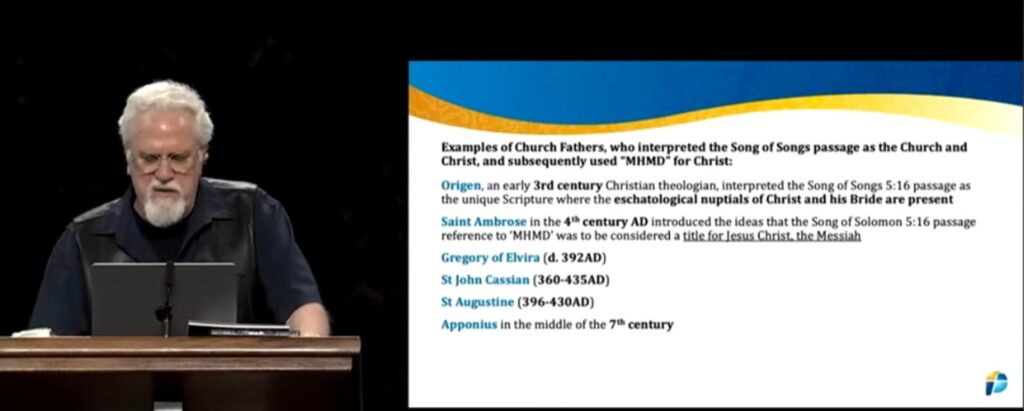
Origen never said that “MHMD” applied Christ
Origen does not have a surviving commentary on Song of Solomon 5. His extant commentary stops at chapter 2. Origen does not cite 5:16 in any other surviving work, either. Therefore, Jay Smith’s claim that Origen said anything about Jesus in Song of Solomon 5:16 is a blatant falsehood. Jay never had a source, because no such source exists. Nor is the Chino Hills presentation, where he read from the slide above, the only place where Jay has made this false claim. In “Did Muhammad Exist? Dr. Jay Smith Responds to Raymond Ibrahim’s accusations,” Jay Smith says, “[Makmed/MHMD] is not a name, though. It is a title. … It was employed by the Christian church and Jews in the 4th century BC … From the 4th century on, in Christian texts, [Makmed/MHMD] was used to refer to Jesus. There are many early church fathers that employed it. You have Origen who interprets the 5:16 passage as the unique Scripture where the eschatological nuptials of Christ and his Bride are present.” Again, in an October 17, 2024, stream on Robert Spencer’s new book, Jay Smith also says, “Do you know who the Makmed/MHMD is? … Ambrose in the 4th century, Ambrose the Father says clearly that the MHMD/Makmed is the Anointed One, the praised one, the Messiah. From that time on, you have Church Father after Church Father referring to the Makmed/MHMD. Origen refers to him.”
When Jay Smith was corrected, he spoke dishonestly about what he had been saying. Skipping the places where Jay Smith chose to misrepresent the concerns of those who contacted him, this is what he wrote and what he reinforced verbally:


Why is Jay Smith claiming that he never said that the Church Fathers used Makmed/MHMD, when he said this many times?
How severe is his cognitive impairment that he can’t remember that he even gave this title to one of his streams?

Jay Smith does not even accurately represent what Origen holds about the Song of Solomon in general terms. Origen does not read it eschatologically. He reads it as the journey of the Soul of the believer, who becomes spiritually united to Christ with no reference to end-times. And every exegete who is considered to follow in Origen’s tradition who exegetes this passage sees the Soul as the one who becomes “totally desirable,” not Christ, because in the text, this is a description of the Body of the Beloved and therefore the Church.
When Jay Smith and Mel of Islamic Origins were informed that they were using AI hallucinations, they doubled down anyway. In their stream together, Mel induces AI to provide him with a hallucination that he has already been told cannot exist to back up the veracity of the names that were previously created by AI hallucinations. The quote it provides is this: “What else is meant by altogether desirable than that Christ in his entirety–his words, his deeds, his mysteries–is the delight of the soul that loves him?”
The reference the AI provides is “Origen (via Rufinus), Comm. in Cant. Cant III. 14 (on 5:16)” An observant researcher would instantly be perplexed as to why the reference is both “on 5:16” and “Cant. III 14”. Either this is on 3:14 or it is on 5:16, not on both. An ethical scholar would look up any citation fed to them by AI before repeating it as fact, and then Jay and Mel would have found that this source doesn’t exist. A person with two braincells to rub together to keep warm would be made suspicious by the em-dashes that the ChatGPT output placed in both the English translation and the Latin and would be deeply suspicious of the neat list of three items, which is a strong preference of LLM-generated output.
But Jay Smith and Mel did not make any of these observations or make any effort to check the citation. Yet they still could have been saved from promoting fraudulent material just by paying attention. They had already been explicitly told that no version of Origen’s commentary survives beyond his analysis of chapter 2. But neither of these men were ashamed to present this AI hallucination as fact. It is academic fraud to present a citation from a secondary source as a primary source. Jay Smith never even possesses that secondary source–his own source is Mel, a tertiary source, whose bad work he then distorts further. Jay Smith spent approximately 18 years in a PhD program before managing to finally complete a doctorate, in addition to his years in undergraduate study and all the years earning two different master’s degrees. Altogether, this is close to thirty years in post-secondary education. In all this time, surely Jay Smith must have been taught what constitutes academic misconduct, yet he practices misconduct on a mass scale in every presentation that he makes. Jay Smith cites people he has never read, sources he has never looked at, and he makes false claims about what his supposed sources say.
To make matters even worse, Mel and Jay are incapable of even presenting this fabricated, fraudulent quote with honesty. Mel says, “According to Origen, ‘muhammadim’ refers to see Christ. I don’t see how we can get away from that. Even if he doesn’t use the word ‘makmed/MHMD,’ he is using the translation.” Here, Mel is using this false hallucination as a basis to assert that if a Father says the adjective “desirable” in Greek is applicable to Christ (this is statement 1 above), then necessarily, “Makmed/MHMD” is a title of Christ (statement 4).
This is transparently fallacious. Yet Jay swiftly chimes in to scornfully mock how stupid anyone is who disagrees with this evidence: “I think like I’m a school student right now. The fact that you have to explain it so simply that everybody gets it is to me a little laughable, but I think everybody gets your point.”
School students know they get flunked or expelled for committing academic fraud, but Jay Smith can’t remember that.
Jay doesn’t even pick up on the fact that Mel thinks that the Greek Origen (d. ca. 253) is using the Latin of Jerome (d. c. 342-5).
In fact, in his speeches, Jay Smith is now so confused that he claims that Ambrose (d. 397), a Latin Father, wrote in Syriac and introduced the use of “makmed/MHMD” to Christian circles and then the 3rd century Origen picks it up from him: “From that time on, from the 4th century AD, this Makmed/MHMD was employed by many of the Church Fathers.” Jay Smith makes this mistake because he heard the claim about Ambrose first, on November 4, 2023, and at that time, Jay came away with the impression that Ambrose was the first to introduce “Makmed/MHMD” as a title of Jesus to Christians. Later on, Mel brought him the additional AI hallucinated list that included multiple Fathers who were earlier than Ambrose. But having already made up a story in his mind, Jay Smith was not able to change his understanding to accommodate these additions in a coherent way. So his narrative is now not only riddled with errors but requires time travel. This demonstrates a severe cognitive deficit.
It is starkly evident that Jay Smith is not a man who is capable of handling any material responsibly any longer, much less the Word of God he is now gleefully violating every time he stands before an audience. These are disqualifying faults that disallow him from leading even a Bible study group, much less teach to thousands. Anyone who loves him should stop him from doing this, as those who teach are held to a much higher standard that other Christians. Even if Jay Smith isn’t capable of understanding how severe his cognitive decline has become, those who stand him up to speak to Christians are liable of fault. Even if he cannot understand the severity of the sin, those who can will be guilty of it.
Saint Gregory of….Elvira? Nyssa? never said “MHMD” applied to Christ
The next person in Jay Smith’s list is “Gregory of Elvira.” Sometimes, Jay Smith even gives a date for Gregory of Elvira’s work in which he uses Makmed as a title of Christ as 392. This name is from list that was generated by ChatGPT. Neither Jay nor Mel has ever given a quotation from Gregory of Elvira on Song 5:16, not even one hallucinated by AI. Yet Jay falsely claims that he and Mel “unpacked” this together.
Gregory of Elvira is a Latin Father. There is no surviving material on Song of Solomon 5 at all–his extant commentary ends at 3:4, in the Tractatus de Epithalamio that was originally falsely ascribed to Origen (as a translation). Even so, we find in Catena’s translation of the surviving text on 2:6 that the “body of Christ” is exegeted as the Church, as expected: “These two hands are the two covenants of the old law and the gospel. When it refers to his left hand, it indicates the old covenant, but the right hand is the preaching of the gospel. The old covenant is inferior because it is placed beneath the head of the church, who is Christ, whereas the right hand embraced the church, meaning that old sins were covered by the sacraments of the gospel. Whoever goes forth in faith, therefore, and serves Christ with devotion, leaves the old person beneath himself and embraces anew the body of Christ, which is the church.” In the embrace of the Bridegroom, the Bride becomes his body.
By graciously presuming that somehow “Nyssa” got changed to “Elvira,” we can turn to the Greek Gregory of Nyssa’s recorded works. Gregory of St. Nyssa is the only Saint Gregory with any commentary on Song of Solomon 5:16. In his Homily 14, he exegetes Song 5:13-16. The description of the body of the beloved is applied to the Church, the Body of Christ, not Christ properly, throughout all 14 surviving homilies. For example, of v. 13a he writes, “So there must be jaws too in the body of Christ, for the benefit of those who are no longer attached to the breasts of the Word but are already longing for more solid food, and it is about these that the Bride is now speaking as she says: His jaws are like bowls of spice pouring forth perfumes.” Of v. 14b, “his belly is as bright ivory overlaid with sapphires,” St. Gregory says, “Such, then, is the model to which the church’s belly is likened for purposes of praise.
About v. 16, St. Gregory first says, “After these praises, as though summing up the whole beauty of the
Bridegroom, she says: His appearance is like Lebanon the chosen, like cedars. His throat is sweetness, and [he is] through and through desire. This is my kinsman, and this is my close one,| O daughters of Jerusalem. For by these words, I take it, the Bride indicates more explicitly that her praise concerns the visible aspect of the Bridegroom’s beauty (and by “visible” I refer to that which the apostle shapes into a single body out of the individual members that make up the church). For she says that his appearance—that of a single individual—is like the myriads of cedars by which Lebanon is girt on every side, and she shows by her words that nothing low or dwarfed contributes to the beauty of the body’s form, but only what is tall like the cedar and presses upward with its crown.”
Thus, the beautiful body of Christ is (still!) the Church in the description of the Bride.
About v. 16, he says. “Here is how the text goes: His throat is sweetness and entire desire.” Gregory then argues that the throat means especially the speech and then says, “Perhaps, then, one will not be mistaken if one understands this term ‘throat’ to signify the servants and interpreters of the Word, in whom Christ speaks.” After giving examples of how the prophets gave voice to sweetness, he says, “That is why she [the Bride] names the whole of him desire, as if she were capturing the beauty of the One she sought in a kind of definition | by this word, for it says totally desire. How blessed are the members through whose contributions the whole body becomes desire! By their perfection in every good thing they produce a fascinating beauty blended out of all of them, and the result is that the whole body—not only the eye and the hair but also the feet and hands and legs and around the throat—is desirable, and, because of the transcendence of its beauty, none of the members is counted inferior.”
This is about the Church and a reference to 1 Corinthians 12:12-27. Throughout all Gregory’s exegesis, the beloved’s body is the Church as a whole. It is a falsehood that “entire desire” refers to Jesus in any other way.
It is important to remember that Jay Smith is falsely ascribing to Christians recognized as saints things they did not teach: “this Makmed/MHMD was employed by many of the Church Fathers.”
And as another reminder, when Jay Smith was contacted to correct his falsehood, he showed this slide and spoke more untruths to avoid accountability:
Cyril of Alexandria calls the body of the Beloved the Church
Mel’s AI prompt did not spit out Cyril of Alexandria’s name, so Mel did not give it to Jay Smith as a Father who supported their thesis. Cyril says nothing that survives on 5:16, but for 5:15, he clearly interprets the body of the Beloved to be the Church: “‘His legs are pillars of marble.’”’ These are clearly foundations, for whoever builds does so upon the foundation of the apostles and prophets. He aptly praises the legs after the belly, who says that marble is set upon bases of gold. Peter and John are pillars of the church, for example, who had Christ, called by a golden name, as their foundation. And they are marble, for Paul also calls them a pillar, surely on account of their stability and consistency, sustaining and supporting the common body of the church, moreover, with their enlightened lives and their saving doctrine….” (Fragments in the Commentary on the Song of Songs). Therefore, the “throat” would logically be another one of these body parts–the Church properly, not Christ.
No early Latin Father applies the phrase “totally desirable” to Jesus Christ
Having dealt with the two Greek false citations, we pass now to the Latin. At least in Greek the word “desire” was a noun, which is at least grammatically conceivable as a title. In Latin, however, it is an adjective: desiderabilis. In Jay Smith’s script, he lists five or six Latin Fathers (depending on whether Gregory is counted) whom he falsely says have called Jesus “Makmed/MHMD.” These are, again, in a list hallucinated by AI with no citations until after they were challenged, except for the AI hallucination of Ambrose which Mel began with. The other names had never been “unpacked” before then, contra the assurance of Jay. Jay Smith should be aware of how trivial it has become to search thousands of YouTube videos and use a tool to see if he has actually done something before he makes false claims about it to thousands of people while slandering those who are trying to save him from the sins that he is committing by presenting lies about Scripture and the Church.
Saint Ambrose never said that “MHMD” applied Christ
Jay Smith frequently repeats fabrications about Saint Ambrose, a Doctor of the Church in the West, that Jay has no reason to believe are true.
Neither he nor Mel were capable of locating Ambrose’s treatise in which he referenced Song of Solomon 5:16, which is called On Isaac and the Soul. In 7:60-1, we find this: “Good, however, lacks nothing, abounds in itself, provides measure and perfection, and also gives a purpose to everything, upon which everything depends. This is the nature of good, which fills the mind. The pure soul revolves around this, contemplates it, and sees God, and abounds in all good things. Therefore, it says: The throat sweetens, and the whole desire.” There is no application of this verse, much less MHMD, as being a title of Christ. The soul is abounding–it is the thing that has become the whole desire.
Here is the stream in which Mel first taught Jay Smith that St. Ambrose used the word “Makmed/MHMD” as a title for Christ. This is the “unpacking” that supposedly proves that Jay Smith’s statements about Saint Ambrose are not a fabrication.
This is what Mel says: “I’m sure I could have picked any number of Christian writers down through the centuries, but St. Ambrose writing in 387 AD interprets Song of Songs as being about Jesus and his church. …. Now when we go to verse 16, it’s now referring back to Jesus. So it’s like the Church is responding to Jesus and saying, ‘His mouth is sweetness itself. He’s altogether lovely. This is my beloved. This is my friend, Daughters of Jerusalem.’ So that’s how the Church interpreted that. So makmedeem/MHMD, for Christians, right up to the seventh century, when they saw it in the Bible, they would have interpreted it as referring to Jesus. They would have been scratching their heads if someone said, ‘Oh it’s to do with an Arabian Prophet. They would have said, ‘Don’t be ridiculous. This is actually to do with Jesus.’ That’s how they would have interpreted it, and they would have interpreted it that way for literally 700 years okay now. … So what is makmedeem/MHMD then? It’s um it’s a reference to Jesus. It’s Jesus being referred to as the Messiah.”
One note before we go on: Mel has no idea what language Christians were reading the Bible in. He believes Ambrose and everyone else were using Hebrew. This is the man that Jay Smith holds up as a historian of a superior caliber.
Jay then restates what he believes is established here: “So already we’re seeing now that this word Makmed or Muhammad or however you want to pronounce Mahmet/MHMD…. This is very early, we’re talking about 1000 BC. Here it is in Song of Solomon chapter 5 verse 16! And then in the 4th Century ad St Ambrose actually takes it [MHMD] and uses it to apply this verse to apply to Jesus himself, which is what the church did and continued to use. It was always refer referring to Jesus up until the 7th Century, proving our point that that this is well known within the church!”
This is all it takes for Jay to being inventing wicked fabrications about Saint Ambrose, about whom Jay clearly has no prior knowledge. He says, “In 397 we have this...let me get his name right, his name is St. Ambrose.” You don’t say, “let me get his name right” about someone you know anything about. This is the first time Jay Smith has heard of this Father, this Doctor of the Church, as far as his memory can serve him! He continues, “St. Ambrose, so we are talking about the 4th century AD. We’re talking 300 years before Islam. St. Ambrose took this word out of Song of Solomon, this reference to Makmed/MHMD, and referred it to Jesus Christ as the altogether lovely, the praised one, the Messiah. And so he started this action in the fourth century of referring to the Makmed/MHMD. That is in the Song of Solomon 5:16.” He then claims this is also the case of Proverbs 12:12, which has the HMD-root in the verb “covet” and in Psalm 68:16, which has the same root in the verb “desired,” as if they’re about Christ!
At Chino Hills, he adds a new confabulation to claim Ambrose is working in Syriac: “Now by the 4th century, Saint Ambrose, the early Church Father, …. writing in Syriac, talks about this Makmed/MHMD from Song of Solomon 5:16. And he says, ‘This is a title for Jesus Christ, the Anointed One, the Messiah‘–that’s what the Anointed One is. From that time on, from the 4th century AD, this Makmed was employed by many of the Church Fathers.”
This statement is pure falsehood. St. Ambrose of Milan wrote in only Latin, and there is not the slightest indication that he knew a single word of Syriac. Jay confabulated that he wrote in Syriac because it makes a good story, and Jay had never heard of Ambrose before Mel gave him this name. This is how Jay decides what to teach publicly today, by making up stories in his head that please him and saying them aloud. Ambrose never wrote the word Makmed, Machmad, Muhammad, or MHMD. And he never claimed it was a title of Christ.
When called out on such an obvious statement, Jay pretended that it was just a small unintentional mistake that he made to claim that Ambrose worked in Syriac. But Jay often says that Ambrose talks about MKMD/Makmed and that Ambrose recognized that the Jews were all talking about the Messiah as Makmed. What language did Ambrose supposedly recognize MHMD/Makmed in? What language were all the Jews that Jay constantly claims that Ambrose is reading or speaking to talking about MHMD/Makmed in? Jay’s claim that this was an innocent mistake is simply not plausible.
In another public presentation, after falsely claiming that every Hebrew scholar would identify MHMD with “the anointed one,” Jay Smith says, “Subsequently, St. Ambrose noticed what the Hebrews were noticing and said, ‘This is the Messiah the Jews are waiting for. Well, we know who the Messiah was. The Messiah is Jesus Christ. We’re waiting for him again, a second time.’ … Therefore in the 4th century, he said, ‘The Makmed/MHMD’–this in Arabic. it’s also in Aramaic, it’s also in Syro-Aramaic–‘that Makmed/MHMD is Jesus Christ.‘”
All of this is the most flagrant fabrication. Ambrose never said anything like this. It’s also not in any language at all that it’s used as a title, and “Syro-Aramaic” is from the title of pseudo-academic book and is not an actual name for a language. But Jay Smith is no longer constrained by truth. He repeated almost the same thing on the Countdown 2 Eternity channel the the pastor of Calvary Chapel Signal Hill. He was then invited to repeat this falsehoods and mislead the pastor’s congregation about the meaning of God’s Word and what ancient Christians believed, which he cheerfully did.
It bears pointing out again that when Jay Smith was contacted to correct his falsehood, he showed this slide and spoke more untruths to avoid accountability:
Let’s look at the description that Jay Smith uses for this video and see whether this is another untruth: “In 387 AD, however, Saint Ambrose maintained that the word ‘machmad’ in Song of Solomon was to refer to Jesus. It was this meaning which the church then applied to this word all the way up to and including the 7th and 8th century, when the Qur’an was supposedly written. Therefore, both the Jews in 1000 BC and the Christians in 387 AD had used this word “MHMD” long before the Muslims then grabbed it and applied it to their prophet sometime in the 8th century AD, proving yet again that the man Muhammad wasn’t a historical figure at all, but was nothing more than a borrowed name taken from the Jews and Christians before them, much they did with our scriptures.”
In another stream, with Mel nodding along, Jay says, “[Jesus] is the M-H-M-D, Mahmad of Hebrew, but [the MHMD/Makmed is] also the one Ambrose designated in the 4th century for Jesus Christ.”
Again, this is falsehood.
In an October 17, 2024, stream on Robert Spencer’s new book, Jay Smith also says, “Do you know who the Makmed is? … Ambrose in the 4th century, Ambrose the Father says clearly that the MHMD//Makmed is the Anointed One, the praised one, the Messiah. From that time on, you have Church Father after Church Father referring to the Makmed.” This is where he then rattles off his AI-generated list.
Yet again, he says, that MHMD/Muhammad was not a name but “it was a title…it’s right there through the Old Testament, from the 4th century on by St. Ambrose and in the Christian community referring to Jesus.” He repeats nearly identical claims here.
Utter falsehood, again. The word is never a title in the Old Testament and was never used by any Christian before Islam in any surviving text.
Here again, Jay Smith claims St. Ambrose applied the title MHMD/Makmed in Song 5:16 to Christ and called said that he was “the praised one, the lovely one, the altogether lovely, the Messiah.”
This is all falsehood.
Here, Mel and Jay work together to re-tell their folie a deux, with Mel affirming that St. Ambrose was “taking the word MHMD/Makmed” and applying it to Christ. Jay chimes in that he applies MHMD/Makmed to “the anointed one, who was the Messiah.” Here is a screenshot with the caption that Jay Smith himself added.
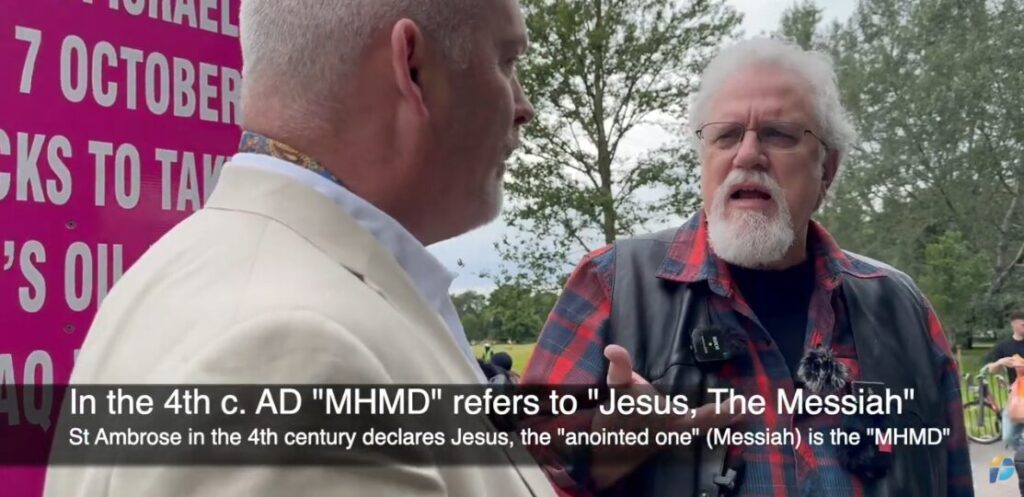
This is falsehood.
There are additional instances where Jay repeats similar falsehoods repeatedly. He is unrepentant. He may be incapable of understanding any longer the difference between truth and falsehood.
Jay Smith and Mel produce an AI hallucination after being told where Ambrose exegetes Song of Solomon 5:16
When Jay Smith was told that Mel of Islamic Origins was feeding him AI hallucinations, he was informed of the actual source for Ambrose’s exegesis, On Isaac and the Soul. He then told this to Mel. Even the name of the work, Mel and Jay Smith, working together, were unable to locate the text in question.
Instead, Mel just asked ChatGPT what the passage said about Song of Solomon 5:16. Because this work was not indexed, ChatGPT made up a wrong citation (chapter 8; it is in chapter 7) and made up a quote: “The soul finds in Him every delight; in His words, sweetness; in his sacraments, beauty; in His mysteries, desire. Therefore is He called altogether desirable.”
ChatGPT also didn’t even get the name of the work correct in Latin. Every half-educated person knows that the Latin conjunction “and” is “et,” but somehow, Mel and Jay, who are making what should be nuanced linguistic arguments, accepted De Isaac, vel anima as the name of the work when it should be De Isaac et anima, without the stray comma intruding into the title. There are other tells that this is an AI hallucination, such as the structure. ChatGPT loves groups of threes and it loves generating comparisons and contrasts. Both are evident here.
Jay Smith was also explicitly told that 5:16 was applied to the soul and not to Christ by Ambrose. Neither Jay nor Mel somehow found it suspicious that the exact opposite was produced by Mel’s ChatGPT prompt.
One again, this is the real text: “Good, however, lacks nothing, abounds in itself, provides measure and perfection, and also gives a purpose to everything, upon which everything depends. This is the nature of good, which fills the mind. The pure soul revolves around this, contemplates it, and sees God, and abounds in all good things. Therefore, it says: The throat sweetens, and the whole desire.” That is, in a an easier-to-understand paraphrase, the Scripture says ‘the throat becomes sweet and wholly desirable’ of the soul who contemplates the good. Nothing here about this applying the word “desirable” to Christ.
The fact that Jay Smith used and AI hallucination to defend himself from accusations of using AI hallucinations shows either a disqualifying lack of discernment or a disqualifying indifference about the truth.
Saint John Cassian never said that “MHMD” applied to Christ
There is no record that John Cassian ever produced a commentary on Song of Solomon or that he ever referenced Song of Solomon in 5:16. This is, again, pure AI hallucination.
All that John Cassian says on Song of Solomon is this: “We must now speak of the renunciations…. The first is that by which as far as the body is concerned we make light of all the wealth and goods of this world; the second, that by which we reject the fashions and vices and former affections of soul and flesh; the third, that by which we detach our soul from all present and visible things, and contemplate only things to come, and set our heart on what is invisible…. To these three sorts of renunciations the three books of Solomon suitably correspond. For Proverbs answers to the first renunciation, as in it the desires for carnal things and earthly sins are repressed; to the second Ecclesiastes corresponds, as there everything which is done under the sun is declared to be vanity; to the third the Song of Songs, in which the soul soaring above all things visible, is actually joined to the word of God by the contemplation of heavenly things” (Conference 3).
So once again, this follows in the pattern of Origen seeing Song of Solomon as concerning the mystical union of the Soul with God. It is highly unlikely that he would apply the words “totally desirable” to Christ, since the others who had this reading did not.
Again, Jay Smith falsely ascribed what Saint John Cassian did not believe or teach to him, being in this list that Jay says supports the statement, “this Makmed/MHMD was employed by many of the Church Fathers.”
And once again, a reminder that when Jay Smith was contacted to correct his falsehood, he showed this slide and spoke more untruths to avoid accountability:
Apponius never never said that “MHMD” applied to Christ
Jay Smith never provides a quote or a work in which Apponius supposedly said that MHMD applies to Christ. Apponius does have a long existing Commentary on the Canticles of Canticles and does cite Song 5:16. But of course, it doesn’t say what Jay claims it does: “Moreoever, his election is compared to a cedar because it grows daily for the increase of its body, which is the Church. Like cedar trees, they are said to always grow and increase, as the prophet says: ‘Just as a palm will flourish, and like the cedar that is in Lebanon, it will be multiplied’ (Ps. 92:13) ‘His throat is most sweet and totally desirable. This is my beloved and this is my friend, O daughters of Jerusalem.’ The throat of our Lord Jesus Christ seems to me to be understood as those who have so removed themselves from all worldly business, seizing upon true philosophy; that not the works of men, …. And therefore he who is made the throat by the above-mentioned things makes the whole body of Christ desirable, when men see his good works and glorify God the Father, because he has made himself most sweet in every way, despising all things.”
Here it is exceptionally clear that “totally desirable” is about the believer and the Church as a whole. It does not apply to Jesus properly.
Yet he is among the Christian saints that Jay Smith is falsely claims is among those who employed the word Makmed/MHMD.”
Saint Augustine never said that “MHMD” applied to Christ
There is no authentic Augustine reference for Song of Solomon 5. There is a work that was wrongly ascribed to Augustine, now referred to as Pseudo-Augustine, in a work called “On the Christian Life.” It reads:
“A man of God should so appear and conduct himself that there would be no one who would not desire to see him, no one who would not wish to hear him, no one who, having seen him, would not believe that he was a son of God, so that truly in his case the prophetic words would be fulfilled: ‘His throat [is] most sweet, and he is all lovely.'”
This is about a man of God, not about Christ at all.
Mel never shared a quote on a stream with Jay. However, on his own channel, he featured a hallucinated quote from Augustine’s Expositions on Psalms 44: “The Church recognizes in Christ her Bridegroom, of whom it is sung, ‘He is wholly desirable.’ For in Him there is nothing that does not delight; He is altogether fair, altogether good.”
This source exists, but this quote is not found in it. It is another AI hallucination. Thus, Mel had no valid reason to ever believe Augustine applied “totally desirable” to Christ and only prompted ChatGPT to generate a quote when he was called out.
When the warning that Mel uses AI hallucinations was sent to Jay Smith, he was not bothered by the fact that Mel had been deceiving him. Instead, Jay and Mel united to claim that they had gotten it right.
For once, with regard to Augustine, Mel managed to find one citation that was not an AI hallucination. He found it, using AI, from within a priest’s homily. But he cited it as if it came directly from Augustine’s work. And then Mel used free association in English to suppose that if Augustine said of Christ “there is love in your delights,” then delights = desirable, and so Augustine called Jesus Makmed/MDMH. This is wildly irresponsible. But if Mel had bothered to do a little research, he would have discovered that the quote was from a translation that only appears on the Catena app, and it had an error in it that changed the meaning. The Catena translation says, “the harkening bride replies, ‘There is love in your delights.'” The Latin actually reads, “the bride who there hears, ‘Charity is in thy delights.'” (Schaff’s translation is correct.)
So the Latin word is “deliciis,” not “desiderabilis,” and the Bride hears this said to her. She does not say this to Christ. This is a quotation of Song 7:6, which is spoken to the Bride in Scripture, too. By Mel and Jay’s logic, then, Makmed was a title of the Church!
Neither Mel nor Jay are competent, ethical, or responsible researchers. They both make up stories and teach falsehoods, and when corrected, they weave more false tall tales to try to rescue or deny the falsehoods that they have been telling. While committing this wickedness, Mel sneers that those who deny that Augustine would have this interpretation are “simply not aware of how he interprets the Bible.” But Mel, who has freshly prompted ChatGPT to give him some talking points, who has never read any of Augustine’s work, and who finds actually tracking down sources to verify them too difficult and tedious–this Mel claims to be so deeply versed in Augustine’s use of the four senses of scripture to the point that he can psychically detect exactly what Augustine’s allegorical interpretation of a passage would have been if only Augustine had written it down. (Mel can’t even coherently articulate Augustine’s four senses of Scripture, though it is quite simple to understand.)
Toward the end of this stream, Mel admitted that he did use at least one ChatGPT hallucination previously, saying that he has now “triple checked”–which is a lie by implication that he had previously checked anything–and realized that “one part” is an AI hallucination. But he still does not understand the severity of his academic fraud or even how ChatGPT works because he believed it still gave him an accurate summary of Augustine which it wrongly spat out as a quote.
He then made a completely outrageous statement that Jay did not seem to understand: “But it’s hard to find these quotes. Like you know, an awful lot of the church father’s material is lost and and it’s hidden behind pay walls. So like be fair like we’re trying our best to find these quotes and even the bits that I was able to confirm here and share it took me a few hours today to find those. They’re very hard to find but they are there.”
This shows that Mel believes that ChatGPT is able to access lost material–things that no longer exist! It also shows that Mel feels it is unfair to have to make sure that what he is presenting isn’t made up because it takes time and effort to do proper research–a few hours, even! And the irony is that Mel is lying in this statement when he claims that he was able to find the patristic quotes that he used in this livestream, because the new Ambrose and Origen quotes are both AI hallucinations, and the Augustine quote not only isn’t about the relevant passage but is simply wrong.
Again, remember that Jay Smith falsely ascribed to Christians recognized as saints things they did not teach: “this Makmed was employed by many of the Church Fathers.”
And once again, a reminder that when Jay Smith was contacted to correct his falsehood, he showed this slide and spoke more untruths to avoid accountability:
And again, let us recall a final time what Jay Smith titled one of his own streams:

An academic’s argument for “MHMD” being recognized by Christians as being related to Christ
Mel of Islamic Origins was inspired to create this argument using AI prompts and hallucinations because he became enamored by the INARAH Institute’s thesis that “MHMD”/Muhammad had some kind of messianic meaning for Jews and Christians before Muhammad. In a previous article, I explained how Volker Popp, who has no academic credentials, linguistic training, or working linguistic knowledge, invented a claim that in Ugaritic, the letters MHMD could be said to signify “chosen one.” He did this through free association in the English language, using the equivocation fallacy. He then found the word “chosen” in a very different context in a hadith in a German translation to claim it had this meaning in Arabic, too, when the Arabic hadith was entirely missing the phrase he asserted was so meaningful.
This is the entirety of the “evidence” for this supposed link to MHMD meaning “chosen” or being a title, with the full weight of all real evidence ranged against it.
Robert M. Kerr is the director of the INARAH Institute and one of the very few members with training in linguistics and academic credentials. Before devoting himself to trying to use revisionism of Islam to cast doubt on the authenticity of Christian orthodoxy, he made meaningful contributions in Punic epigraphy. Now his pseudo-intellectual sophistry is no longer published in reputable journals.
Kerr tried to use his better education to salvage the argument that “MHMD” has some kind of messianic connection in the minds of Jews and Christians. In contrast to Popp, he did this without statements that were as clearly prima facie absurd and without much outright lying. It is most significant that Kerr never argues that MHMD is a title. He knows this is grammatically impossible and ludicrously stupid to claim about its uses in Arabic. He also knows perfectly well that it was an existing name in Arabic, but he doesn’t want it to be a name in an early Islamic context, because then it would refer to a specific person with the literal name Muhammad, and he does not want that person to exist.
Kerr wants MHMD to be an adjective that is used in order to evoke Jesus. His attempts to force MHMD to be an adjective are contextually absurd, as well. He is forced to argue that muhammad is part of an unattested phrase and the noun part of the phrase is just implied in every instance, leaving the adjective to stand alone in its place. This could be seen as grammatically possible, yes, but logically stupid. Where is there any evidence of this implied noun? Why would you have such an informal structure in the most formal statements? But it’s even dumber from a historical standpoint. Has there ever been a stand-alone adjective that, when used, invokes the Messiah? No, because the idea is idiotic. An adjective can’t take the function of a title. Man of Sorrows, yes. “He is sorrowful” would make no one believe that Jesus is the referent without having previously established that this is Jesus in some way. Even “he is anointed” could mean any anointed person as a bare description. All Christians have an anointing. “Chosen,” too, is used just as freely of God’s elect om Greek. Adjectives need context for them to invoke one individual over another. The idea that a free-floating adjective would come to have such weight would need examples–real examples, outside the texts that Kerr is trying to twist to change their meaning.
And of course, Kerr uses free association to try to make his argument rather than presenting any actual evidence. His work where he does this, “Du désir à la louange. À propos de la racine ḥmd et de la « préhistoire » de Muḥammad,” is in French, a language that Jay Smith claims to know, and so it should be easily accessible to Jay. There is no evidence, however, that Jay has ever read most of the work that he claims to be citing, and he certainly has not read this article.
Robert Kerr freely admits that the meaning of the root HMD in Ugaritic is “desire,” and it has no other meaning, and that this is the same for other Northwest Semitic languages (p. 225-231). He admits that the native meaning in Arabic is “praise,” which it is also in Old South Arabian and in Modern South Arabian (p. 231-237). (The final point was only recently confirmed by the decipherment of this script.) He admits that the root is well-attesting in Old South Arabian and Arabic inscriptions as an ordinary name.
But he wishes to argue that sometimes, most especially in the Quran, Arabic chooses to import the Northwest Semitic meaning of “desire” in place of the native meaning. He does this by making an absurd argument that the Quranic sentences that contain both the words “praise” and “glorify” make no sense because these words have too similar of a meaning and so would be redundant. He argues that really “praise” must have the Aramaic meaning of “desire” and “glorify” must have the meaning of “praise.” Then he cherry picks a few sentences where this change doesn’t sound ridiculous and ignores the ones where they do, except this particularly goofy example, where he changes, “the thunder glorifies Allah with his praise” to “the thunder praises Allah with his desire” (p. 224). How do you praise using desire, pray tell?
He especially wants to argue that the structure “Praise to Allah, the one who (does whatever)” fundamentally does not make sense. He does not like “the one who” following “praise” because he believes that the structure with “the one who” has an implied causality that makes “praise” inappropriate. Of course, most Christians would be familiar with “Praise God, From Whom All Blessings Flow.” There is implied causality with “praise.” There is nothing strange about it. In the pagan hymn The Exaltation of Inanna, we find this: “Praise be to the destroyer of foreign lands, endowed with divine powers by An, to my lady enveloped in beauty, to Inana!” Implied causality again, and nothing weird about it. In another hymn, we find this: “Praise be upon the lady ruler of men, the greatest of the Igigi!“ This usage, which was not strange to people in 2300 BC, nor in 950 BC, nor in AD 1900, is a foundation for Kerr’s argument, such as it is.
His second argument is that it would be strange to give a baby a name with “praise” as the meaning, so the pagan Arabs whose names were carved in the desert must have meant “desire” instead. There are three issues with this. First, he has already admitted that this root is a name meaning “praise” when it appears in Old South Arabian. Why would it suddenly no longer be appropriate for northern Arab tribesmen when southern tribesmen were entirely happy with it? Second, there is no record of the root ever being used for any name in any Northwest Semitic context. Why would Arabs borrow a name that no one who spoke the language thought should be a name? And third, in isolation, the Northwest Semitic meaning has sexual overtones. Why would a name about your child being admirable be objectionable and one with sexual overtones be preferable?
Kerr again provides no support for this other than his feelings.
Kerr still needs to connect this “MHMD” to Jesus somehow, because he wants it to both have the meaning of the word “desire” and also have a messianic connotation. Note, again, that “praise” in his mind is too grandiose of a base meaning for a child, but something invoking the Messiah is just fine! To do this, Kerr uses many words that mean nothing, trying to claim it is a “technical term of the Old Testament” (p. 237). This is the title of the section, but he is unable to show that this is ever a “technical term” and never mentions this phrase again.
Kerr begins by admitting that the root does not refer specifically to an attribute of God in the Bible. He then denies the connection between the phrases “Muhammad is the messenger of Allah” and Daniel being called the “beloved man” in the Old Testament, pointing out that they are entirely spurious on a linguistic and grammatical level, but he still feels that the idea has a certain merit at a conceptual level because Gabriel brought Daniel messages from God and Muhammad said he was hearing from Gabriel. This is an absurd reach. But Kerr is very excited to tell us that there is a Messianic link here because certain ancient Christians, when discussing Daniel, noted that Gabriel was the angel who made the annunciation to Mary(!). Kerr’s argument is that a basic observation that Gabriel is the angel in Luke means that the Fathers secretly applied the appellation “beloved man” to Jesus instead of Daniel, and everyone knew it and linked that phrase to Jesus even though they never wrote about it even once.
I would like to point out, again, that none of the Fathers Kerr could be calling upon were working with the Hebrew text, and his theory all along has been that Aramaic, not Hebrew, is causing a meaning change for MHMD from the native Arabic meaning. In the Syriac Bible, the word is not MHMD at all but ܓܬܳܐ, rgt), meaning desire or lust. So why would the Greek Irenaeus (see para. 5) and Latin Julian of Toledo (see para. 1) secretly be trying to convey a hidden reference to a word present only in the Hebrew in noting that Gabriel was the angel who visited both Daniel and Mary? Isadore of Seville, his other citation (see 7.5), just gives the meaning of the name Gabriel and mentions Mary and later says that angels visited Daniel without connecting the two directly (p. 238). This is pure sophistry, which is why this work did not find publication in a journal with any peer review by subject matter experts.
To claim that this had special significance to the Jews, Kerr manages a citation that at least connect the Messiah with Daniel being called beloved (p. 240): “Rav Naḥman says: If the Messiah is among the living in this generation, he is a person such as me, who already has dominion over the Jewish people, as it is stated: “And their prince shall be of themselves, and their governor shall proceed from their midst” (Jeremiah 30:21), indicating that the redeemer is already in power. Rav says: If the Messiah is among the living in this generation, he is a person such as our saintly Rabbi Yehuda HaNasi, who was renowned for his sanctity, piety, and Torah knowledge. If the Messiah is among the dead he is a person such as Daniel, the beloved man.” (Sanhedrin 98b.15). Now it is required to show that the rabbis thought not only Daniel should be called “the beloved man” but that the Messiah should be called that. And this he fails to do, because no rabbi ever does this. It is not a term ever applied to the Messiah in Jewish thought.
Then Kerr jumps to the only verse that actually does contain the root HMD in any form in a Messianic context that does not explicitly deny that this applies to the Messiah: Haggai 2:7 (p. 239). This has the form HMDT, a feminine derivation of the root. This form has 18 occurrences. At least 14 are about objects, land, or houses that are precious. One is denying that anyone had valued the king Joram of Judah, saying no one regretted burying him. Another speaks of the sexual desire of women. There is also some grammatical disagreement about whether Samuel promises Saul the wealth of Israel or is saying that Israel longs for him. And the final one is this verse.
Let us look at this verse in context, with the verse before and after, with the most common way modern translations handle it.
- 6 For this is what the LORD of Hosts says: “Once more, in a little while, I will shake the heavens and the earth, the sea and the dry land.”
- 7 “And I will shake all nations, so that they will come with the treasure/wealth of all nations, and I will fill this house with glory,” says the LORD of hosts.
- 8 “The silver is mine and the gold is mine,” declares the LORD of hosts.
There is a bit of ambivalence in the Hebrew, which says literally, “I will shake all the nations, and they will come with/to desire/delight/wealth of all Nations, and I will fill this house with glory.” The form for the word in question is singular, not plural as some modern translations have. (In other places the singular of this word in Hebrew is better rendered by a plural in English, so this is not a point of criticism, once the meaning has been decided upon.) More importantly, there is no explicit preposition. That is, the Hebrew does not say whether they are coming with or to the indirect object. The fact that “come” is plural is irrelevant–the nations are coming, not the wealth/Desire, which is singular. The Syriac contains the same ambiguity but has a different word for “desire,” once again–rgt). Thus, there is no HMD connection in Syriac.
Because the next verse is about silver and gold being God’s, most modern translations take this in the translation above. In pre-Christian times, this was similarly translated into Greek as “And I shall shake all the nations. And the chosen (PLURAL) of all the nations shall come.” This can have the connotation of either the choicest things or the choicest people. It can’t be the Messiah himself.
Jerome’s Vulgate, in contrast, chooses “and the desired (SINGULAR) of all nations shall come.” This does violence to the Hebrew because the coming thing(s) can’t be singular. The New King James, favoring the Messianic interpretation, fixes the grammatical issue by rendering it, “and I will shake all nations, and they shall come to the Desire of All Nations, and I will fill this temple with glory” over the King James, which (like most Catholic translations) follows the Latin to the detriment of the Hebrew.
This was not a passage that many Fathers focused upon. Cyril of Jerusalem, Tertullian, Eusebius, Ephrem the Syrian, Gregory of Nazianzus, Theodore of Mopsuestia, Theodoret of Cyrus, and Gregory the Dialogist all referenced Haggai 2 and have no surviving comments on 2:7. The Greek Fathers could not have read this as referring to a singular Messiah, so it is not surprising they made no comment. Ambrose of Milan referenced only the first phrase, about shaking the nations. Only two Fathers have any commentary which make reference to this passage referring to Jesus, and both were Latins. Of it, Jerome wrote, “according to the Hebrew, the desired one will come to all nations, our Lord and Savior.” Not surprising, as he was the translator. Augustine, using Jerome’s translation, concurred: “Haggai has the following brief but clear prophecy of Christ and the church: ‘For thus says the Lord of hosts: yet one little while, and I will move the heaven and the earth, and the sea and the dry land. And I will move all the nations, and the desired of all nations shall come.'” Kerr, of course, presents these two isolated examples as if they are the normative exegesis in all languages, which is not even possible (p. 240).
From this thin soil, Kerr is needs to make the following claims: “Desire/Chosen of Nations” was a well-known and well-referenced title of Christ in West Asia, where the Latin was not used, to the point that the Hebrew was dug up and applied to Jesus as an adjective. This adjectival application moved unattested into Aramaic/Syriac, and then from Aramaic/Syriac changed the meaning of the same root in Arabic in a narrow context, and then caused Arabs to decide this was a root that should be used to refer to Jesus in an adjective form.
Kerr tries to use the fact that the passage as a whole is seen as having a messianic context to insist that this word has a special meaning. This is not a legitimate leap. The simple fact is that Desire of Nation was never used as a title of Christ even in Latin, which is the only language that had this tradition–much less Desire alone, much less the adjective “desirable”! The phrase in its entirety is recognizable now to English-speaking Protestants, thanks largely to the King James Version, but this is a recent phenomenon. And demanding “desirable” apply to Jesus in a way all Christians would recognize ignores the description of the Messiah that all Christians anciently universally recognized. This, the only physical description of Christ, used same root HMD and denied that it was a quality of Christ in the incarnation: “he had no form or majesty that we should look at him, and no beauty that we should desire him” (Isaiah 52:2b). Running back to this specific Hebrew root and claiming that in isolation it would be a common and recognizable for Jesus is not only without foundation but against all logic.
We have already dealt, in detail, with the foolishness surrounding claims to do with Song of Solomon 5:16, and so there is no need to repeat them here. Of course, it is Kerr from whom Mel of Islamic Origins got this argument, garbled it, and handed it over to Jay Smith, who handled it with all his usual discernment, which is none at all.
Kerr attempts to go to the Targum for support, but it yields none: “The words of His palate are as sweet as honey, and all His commandments are more desirable to His sages than gold and silver. This is the praise of God, my Beloved, and this is the power of the strength of my Lord, my Beloved, O prophets who prophesy in Jerusalem.” The best he can do is point out that the husband is understood to be the Messiah in the Targum, which gets him nowhere. For even less comprehensible reasons, he cites the Talmud, which considers this to be a description of the student of the Torah in the world-to-come.
Rather than presenting outright lies, as Mel and Jay Smith do, Kerr says that some Fathers talked about the verse and used the Greek word “desire” when they did, without admitting to what they said about the text! Why? Because he knows it undermines his position, and no one called Jesus “the desirable” using this passage. Instead, he cagily says this area “needs more research.” Kerr then flails around Song of Solomon as if proving that it expresses basic pre-Christian Jewish and Christian faith gives support to his peculiar philological assertions.
His claim from which Mel and Jay get their absurd pronunciation “Makmed” is due to Mel’s muddled understanding of Kerr’s argument that the Greek versions of Muhammad’s name correspond to the genuine Hebrew form machmad as heard by Syriac speakers. Bluntly, this is idiotic because in the two-syllable versions, the second vowel is always an “e” and never an “a,” when that final “a” is long/accented in the Hebrew. Additionally, the final letter is as often a “t” as a “d,” showing that the Syriac speakers could not have even associated the name firmly with the HMD root. This was, of course, discussed above in more detail. Were Syriac speakers reducing the name to two syllables? Very likely. But it does not correspond to a Syriac word, and it does not even correspond to Arabic Mahmud because the long U would have been impossible to miss. With the form Mwhmd also appearing in Syriac, it seems that Syriac speakers heard “Muhammad” or “Muhammat” but then spoke it in a way that followed their phonetic system more comfortably, in the same way that Anastasia drops a syllable and changes the accented syllable in English pronunciation.
After all this blather, Kerr then declares that his absurdly convoluted thesis is the “Gillette Fusion of Ockham,” the most outrageous attempt to claim that Ockham’s razor is being employed that I have ever encountered. His “Ockham’s razor” declares that Muhammad’s biography was made up of stitched-together themes from all kinds of ancient sources, much of which the Islamic regime would have no knowledge of or access to, which he even more ridiculously tries to claim is combined with a retold biography of Heraclius’ life. The Islamic regime remained almost entirely ignorant of any details of the lives of Byzantine emperors and couldn’t even locate them on the correct continent in the early Islamic sources, yet these sources, according to Kerr, skillfully plucked precise details from Heraclius’ life to borrow into inventing Muhammad. The mind boggles.
Conclusion
Jay Smith is pleased to the distort the Bible and tell fictions about Church Fathers and what they believed to prop up his career as the chief disseminator of the narrative that early Muslims were really Christians–a term he cheerfully extends to those who deny the Trinity and deny Christ is God. In choosing to promote fabrications again God’s holy Word, Jay Smith has disqualified himself from any position that involves any statement about the Christian faith or the interpretation of Scripture. It is to the shame of any who listen or platform him that he continues to have an audience for Scripture twisting and historical fictions.